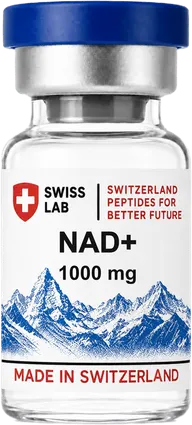
NAD+ — nicotinamide adenine dinucleotide — is one of the most fundamental coenzymes in cell biology. It is present in every living cell, sits at the centre of energy metabolism, and is additionally consumed as a substrate by a family of signalling enzymes. That dual character — a recyclable redox carrier that is also a consumable substrate — is much of why it attracts research interest.
This overview summarises how NAD+ is described in peer-reviewed biochemistry and research-model studies, for orientation within the research community. It does not describe human use, supplementation, infusion, dosing, or therapeutic outcomes, and nothing here should be read as guidance for use in or on humans.
- NAD+ (nicotinamide adenine dinucleotide) is a redox coenzyme present in all living cells.
- It cycles between an oxidised form (NAD+) and a reduced form (NADH) to carry electrons in metabolism.
- It is also a consumable substrate for sirtuins, PARPs and other NAD+-dependent enzymes.
- It is supplied for laboratory research use only and is not approved for human or veterinary use.
What NAD+ is
Chemically, NAD+ is a dinucleotide: two nucleotides joined through their phosphate groups, one carrying an adenine base and the other a nicotinamide group derived from vitamin B3 (niacin). The nicotinamide ring is the reactive part — it accepts and donates a hydride ion, which is how the molecule carries electrons. The notation NAD+ refers to the oxidised form, while NADH is the reduced form. A phosphorylated relative, NADP+/NADPH, plays a parallel role in biosynthetic and antioxidant chemistry. The material described here is the research reference compound, distinct from the intravenous or supplement products marketed to the public.
Biochemical role in metabolism
In its best-characterised role, NAD+ is a redox cofactor. The NAD+/NADH couple shuttles electrons between reactions: in pathways such as glycolysis and the citric-acid (TCA) cycle, NAD+ accepts electrons to become NADH, which then delivers them to the mitochondrial electron-transport chain. Because it is continuously recycled between its two forms, the ratio of NAD+ to NADH is often used in research as a read-out of a cell’s redox and metabolic state.
| Form | Redox state | Role in the couple |
|---|---|---|
| NAD+ | Oxidised | Electron acceptor — takes on a hydride |
| NADH | Reduced | Electron donor — carries electrons to the respiratory chain |
| NADP+ / NADPH | Phosphorylated pair | Parallel couple studied in biosynthesis and antioxidant chemistry |
Redox cycling is only half the story. NAD+ is not merely recycled; it is also broken down and consumed, and that is where the second, faster-moving area of research begins.