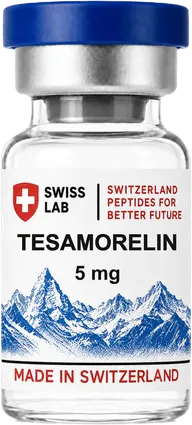
Tesamorelin is a synthetic analogue of growth-hormone-releasing hormone (GHRH), the hypothalamic peptide that signals the pituitary gland to produce growth hormone. It belongs to a family of research peptides grouped under the heading of growth-hormone secretagogues, and it is studied specifically as a stabilized, longer-lived version of the native GHRH molecule.
This overview summarises how tesamorelin is described in the peer-reviewed laboratory and preclinical literature, for orientation within the research community. It does not describe human use, dosing, body-composition outcomes, or therapeutic results, and nothing here should be read as guidance for use in humans. The material supplied by SWISS LAB is a reference compound for laboratory research use only.
- Tesamorelin is a synthetic analogue of GHRH(1-44), the full-length growth-hormone-releasing hormone.
- An N-terminal modification stabilises the molecule against enzymatic breakdown, distinguishing it from native GHRH.
- It is studied as a GHRH-receptor agonist acting on the pituitary GH/IGF-1 axis.
- It belongs to the GHRH-analogue class of growth-hormone secretagogues, distinct from ghrelin-receptor agonists.
- It is supplied for laboratory research use only and is not approved for human or veterinary use.
What tesamorelin is
Tesamorelin is a stabilised synthetic analogue of human growth-hormone-releasing hormone in its full 44-amino-acid form, GHRH(1-44). Native GHRH is the hypothalamic signalling peptide that acts on the anterior pituitary; in the body it is short-lived, because circulating enzymes — dipeptidyl peptidase-4 (DPP-4) among them — rapidly cleave it. Tesamorelin carries an added group at the N-terminus (a trans-3-hexenoyl group) that slows this breakdown, which is why the literature describes it as a stabilised or long-acting GHRH analogue rather than as GHRH itself.
Tesamorelin is also the active ingredient in an approved prescription medicine (marketed as Egrifta) in a specific clinical indication, HIV-associated lipodystrophy. That is a factual statement about a regulated pharmaceutical product. The material described here is not that product: it is a research-use-only reference compound, supplied for in-vitro laboratory work and not manufactured, labelled, or approved for human use.
Mechanism studied
In the research literature, tesamorelin is characterised as an agonist of the GHRH receptor — a G-protein-coupled receptor expressed on the somatotroph cells of the anterior pituitary. Binding at this receptor is studied for its role in stimulating the synthesis and release of growth hormone, which in turn drives production of insulin-like growth factor 1 (IGF-1) in the liver. Together these form the GH/IGF-1 axis, the signalling pathway around which most tesamorelin research is organised.
Because tesamorelin acts on the same receptor as endogenous GHRH, laboratory models describe it as working within the physiological control of the axis rather than bypassing it. This framing — an analogue that engages the endogenous receptor — is a mechanistic description in research models and cell or animal systems, not a demonstrated effect in humans.
How it relates to other GH-secretagogue peptides
Research peptides that raise growth-hormone signalling fall into two broad mechanistic classes, and tesamorelin sits firmly in the first. Understanding the split clarifies where it belongs relative to compounds such as CJC-1295, sermorelin and ipamorelin, which recur in the same research conversations.
| Class | Receptor studied | Representative research peptides |
|---|---|---|
| GHRH analogues | GHRH receptor (pituitary somatotrophs) | Tesamorelin, sermorelin, CJC-1295 |
| Ghrelin-receptor agonists (GHRPs and mimetics) | Ghrelin / GH-secretagogue receptor (GHS-R1a) | Ipamorelin, GHRP-2, GHRP-6, MK-677 |
Tesamorelin, sermorelin and CJC-1295 are all GHRH analogues: they engage the GHRH receptor, differing mainly in the modifications that determine stability and duration. Ipamorelin and the other growth-hormone-releasing peptides work through a separate receptor, the ghrelin receptor. Our companion overview of CJC-1295, ipamorelin and sermorelin sets out this GHRH-analogue-versus-ghrelin-receptor distinction in more detail; the two classes are frequently studied side by side in laboratory models precisely because they act on different receptors.
What the evidence does not establish
The existence of an approved medicine that shares this molecule can create a misleading impression about the reference compound supplied for research. To be explicit, the laboratory and mechanistic literature does not establish:
- Any effect, benefit, or body-composition outcome of the research-grade material — the supplied compound is not the approved medicine and has not been evaluated as one.
- That mechanistic findings in cell or animal models translate to any outcome in humans — this remains a research question.
- Human dosing, routes of administration, or safety for the research material — these are not established and are outside the scope of this overview.
- Equivalence between a research-use reference compound and a regulated pharmaceutical product — they are different things, differently manufactured and controlled.
If you are sourcing tesamorelin as a reference compound for laboratory research, the references below point to the primary GHRH and GHRH-analogue literature, and the product page lists the analytical documentation available for the supplied material.
Frequently asked questions
- Is tesamorelin the same as the prescription drug Egrifta?
- No. The same molecule is the active ingredient in that approved medicine, but the material supplied here is a research-use-only reference compound — it is not a pharmaceutical product and is not manufactured, labelled, or intended for human use.
- What makes tesamorelin different from ordinary GHRH?
- An N-terminal modification stabilises it against the enzymes that rapidly break down native GHRH, so the literature describes it as a longer-acting GHRH analogue. That is a description of the molecule, not a claim about any use.
- How does tesamorelin relate to CJC-1295 and ipamorelin?
- Tesamorelin and CJC-1295 are both GHRH analogues acting on the GHRH receptor; ipamorelin acts on the separate ghrelin receptor. All three are studied as growth-hormone secretagogues in laboratory models.
- Can I use tesamorelin for growth-hormone-related goals?
- No. It is supplied for laboratory research use only and is not for human or veterinary use. It is not a medicine, supplement, or performance product, and no personal-use guidance is provided.
- Is tesamorelin approved for human use?
- The molecule is the active ingredient in an approved prescription medicine in one specific indication, but the reference compound supplied here is unapproved and is for laboratory research only — the two must not be conflated.