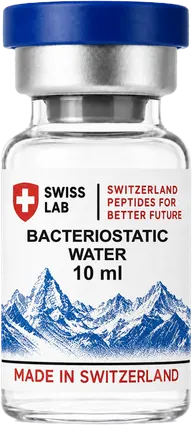
Bacteriostatic water is sterile water that contains a small amount of benzyl alcohol — typically 0.9% — added as a bacteriostatic agent, meaning an agent that inhibits the growth of bacteria rather than killing them outright. That single additive is what separates it from ordinary sterile water and is the reason a sealed vial can be entered repeatedly and used as a solvent over several days of laboratory work.
In a research setting it is most often used as the solvent for reconstituting lyophilized (freeze-dried) research peptides into laboratory stock solutions. This article explains what bacteriostatic water is, how it compares with sterile water for injection and with distilled or deionized water, why the benzyl alcohol matters for a multi-use vial, and how researchers decide between diluents. Everything here concerns the handling of research materials in the laboratory and is for research use only.
- Bacteriostatic water is sterile water with roughly 0.9% benzyl alcohol added as a bacteriostatic (bacteria-inhibiting) preservative.
- The preservative lets a single sealed vial be drawn from repeatedly, which is why it suits multi-use solvent work.
- In the laboratory it is used to reconstitute lyophilized research peptides into stock solutions.
- It differs from sterile water for injection (no preservative, single-use) and from distilled or deionized water (purified but not preserved).
- It is supplied and handled for laboratory research use only — not for human or veterinary use.
What bacteriostatic water is
Bacteriostatic water is purified, sterile water into which benzyl alcohol has been dissolved at about 0.9% by volume. Benzyl alcohol is a well-characterised bacteriostatic agent: at this concentration it suppresses the multiplication of common bacteria that might otherwise be introduced when a vial is opened or a needle is inserted. The word bacteriostatic is precise — the additive holds bacterial growth in check (‘static’) rather than sterilising the contents anew each time (‘cidal’), so the vial stays usable across multiple withdrawals rather than only one.
The benzyl alcohol content is the defining feature. Plain sterile water contains nothing to hold back microbial growth, so once its seal is broken it is intended for a single use. Bacteriostatic water, by contrast, is formulated specifically to tolerate repeated entry — exactly what a laboratory needs when one vial of solvent must serve many small reconstitutions.
How it differs from other water grades
Several grades of water look identical in the vial but behave very differently as solvents. The distinction that matters most for reconstitution work is whether the water is both sterile and preserved. Distilled and deionized water are defined by their purity — the removal of dissolved minerals, ions and particulates — but purity is not the same as sterility, and neither contains a preservative. Sterile water for injection is sterile but unpreserved. Only bacteriostatic water is both sterile and preserved for repeated use.
| Property | Bacteriostatic water | Sterile water (for injection) | Distilled / deionized water |
|---|---|---|---|
| Added preservative | ≈0.9% benzyl alcohol | None | None |
| Sterile | Yes | Yes | Not necessarily (purity is not sterility) |
| Purified of ions / minerals | Yes | Yes | Yes (its defining feature) |
| Repeated draws from one vial | Suitable — preservative inhibits growth | Single-use — no preservative | Not intended as a sterile solvent |
| Typical laboratory role | Multi-draw reconstitution solvent | Single-use diluent | Rinsing, buffers, general dilution |
- With no preservative, sterile water for injection best suits a single reconstitution used up in one session.
- Distilled and deionized water are general-purpose laboratory water for rinsing, buffer preparation and dilution — not for preparing sterile stock solutions meant to last.
- Bacteriostatic water is the grade chosen when one vial must supply solvent for repeated draws over days or weeks.
As a solvent for reconstituting research peptides
Many research peptides are shipped as a lyophilized powder — freeze-dried to a stable solid — because they keep far better dry than in solution. Before they can be used in an assay they must be redissolved, and this is where bacteriostatic water serves as the solvent. The researcher introduces a measured volume of solvent into the vial, lets the powder dissolve gently into a laboratory stock solution, and stores the resulting solution for subsequent measured withdrawals. Our companion guide, “How to Reconstitute Research Peptides,” walks through the general reconstitution workflow in more detail.
The volume of solvent added is what sets the concentration of the stock solution. Because the mass of peptide in the vial is fixed, adding less solvent gives a more concentrated stock and adding more gives a more dilute one. For example, adding 2 mL of bacteriostatic water to a vial holding 10 mg of lyophilized peptide gives a stock solution at a nominal 5 mg/mL (10 mg divided by 2 mL). Researchers choose the solvent volume to reach whatever stock concentration their protocol calls for. This is stock-solution preparation and simple laboratory arithmetic — it describes the concentration of a solution in a vial, not any form of human dosing.
The benzyl alcohol earns its place here: because a single vial of stock solution is typically drawn from repeatedly as an assay proceeds, a preserved solvent reduces the chance that bacterial growth is introduced between withdrawals. That is the same multi-use logic that makes bacteriostatic water the common default for reconstitution.
Storage and handling
Handling practices follow from the same principles that make the solvent useful. A few points are worth keeping in mind:
- Store vials as indicated on the label — typically at controlled room temperature — and keep them sealed until use.
- Wipe the stopper with an alcohol swab before each entry and use a fresh sterile needle to withdraw solvent, so the preservative is not asked to compensate for avoidable contamination.
- Reconstituted peptide stock solutions are generally refrigerated and protected from light; consult the specific peptide’s documentation for its own stability guidance.
- Observe any manufacturer limit on how long a vial should be used after first entry, and discard it if the contents become cloudy or discoloured.
- Label reconstituted stock with the compound, concentration and date so the vial is unambiguous later.
When researchers choose it over other diluents
The choice of diluent comes down to the job. Bacteriostatic water is the usual choice when a reconstituted stock will be drawn from more than once, because the preservative is what makes repeated entry reasonable. Where a solvent must be entirely free of benzyl alcohol — for instance a protocol sensitive to that additive, or a compound with limited solubility in it — an unpreserved sterile water may be selected instead and the single-use constraint accepted. Distilled or deionized water remains the everyday choice for non-sterile tasks such as rinsing glassware and making up buffers.
For the step-by-step mechanics of dissolving a lyophilized peptide, see “How to Reconstitute Research Peptides”; for the solvent itself, the product page below lists what is available.
Frequently asked questions
- Is bacteriostatic water the same as sterile water?
- No. Both are sterile, but bacteriostatic water also contains about 0.9% benzyl alcohol as a bacteriostatic preservative, which allows a vial to be drawn from repeatedly. Plain sterile water has no preservative and is intended for a single use. In this context both are laboratory solvents for research use only.
- What does the benzyl alcohol do?
- It acts as a bacteriostatic agent, inhibiting the growth of bacteria that might be introduced when the vial is entered. That is what allows one sealed vial to serve as a solvent across multiple withdrawals rather than only one.
- Why is bacteriostatic water used to reconstitute research peptides?
- Lyophilized research peptides must be redissolved into a laboratory stock solution before use, and bacteriostatic water is a convenient preserved solvent for that. Because a stock vial is usually drawn from several times, the preservative helps limit contamination between draws. This is laboratory reconstitution of research materials, not the preparation of anything for human use.
- How does the solvent volume set the stock concentration?
- The peptide mass in the vial is fixed, so the volume of solvent you add determines the concentration: 10 mg dissolved in 2 mL gives a 5 mg/mL stock, for example. This is ordinary stock-solution arithmetic describing a solution in a vial — it is not human dosing.
- Is bacteriostatic water for human use?
- The material described here is supplied and handled strictly for laboratory research use only. It is not offered as a sterile product for human or veterinary administration, and the peptides reconstituted with it are research materials, not medicines.