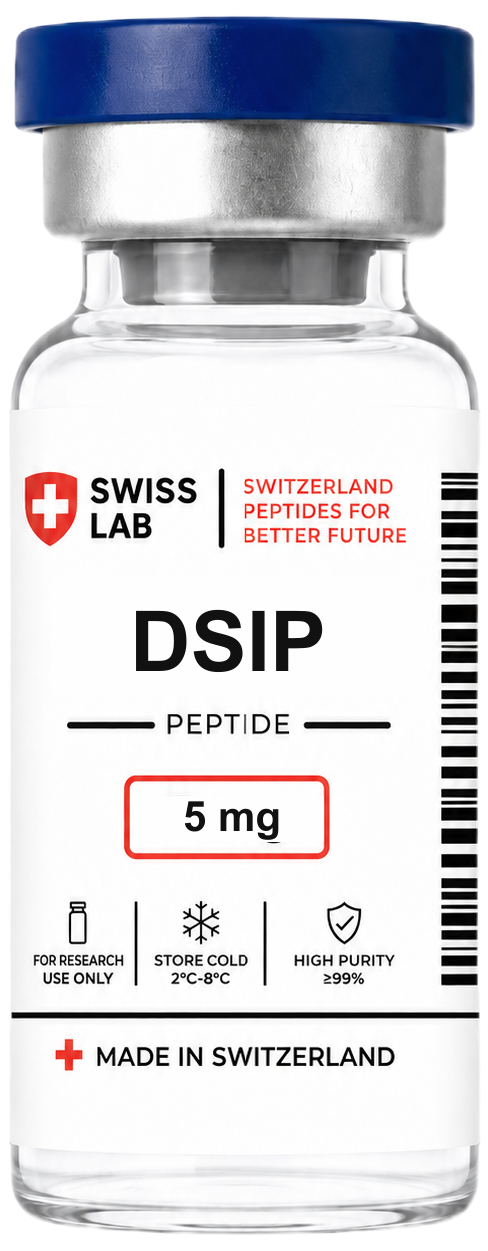
DSIP — delta sleep-inducing peptide — is a nonapeptide with the sequence Trp-Ala-Gly-Gly-Asp-Ala-Ser-Gly-Glu. It occupies an unusual position in the peptide research literature: it is well known, widely sold, and named after a function that its own published record does not establish. Almost everything written about DSIP outside the primary literature takes the name at face value. This overview does not.
The material below summarises how DSIP is described in published laboratory and animal-model studies, as orientation for researchers working with the compound. It does not describe human use, clinical effects, dosing, administration, or outcomes of any kind. DSIP is supplied strictly for laboratory research use — it is not a medicine, and nothing here should be read as a claim about sleep, stress, recovery, or any effect in people.
- DSIP is a nonapeptide, Trp-Ala-Gly-Gly-Asp-Ala-Ser-Gly-Glu, with a molecular weight of approximately 848.8 g/mol.
- It was isolated in the 1970s in Basel by Schoenenberger and Monnier, from the cerebral venous blood of rabbits held in an induced delta-wave sleep state — the name records that experimental setting, not a demonstrated function.
- The sleep literature that gave the peptide its name is old, methodologically inconsistent and largely unreplicated.
- No specific DSIP receptor has been definitively characterised, which limits mechanistic interpretation of the entire literature.
- Supplied for laboratory research use only; not an approved medicine, food or supplement in the EU, US or most jurisdictions.
What DSIP is, and where the name comes from
DSIP is a linear peptide of nine amino-acid residues, unmodified at both termini, with the sequence Trp-Ala-Gly-Gly-Asp-Ala-Ser-Gly-Glu (single-letter: WAGGDASGE). Its molecular formula is C35H48N10O15 and its average molecular weight is approximately 848.8 g/mol. The sequence is unusual in composition: it contains two acidic residues, aspartate and glutamate, and no basic residues at all, and four of the nine positions are glycine or alanine. It is a small, flexible, strongly acidic molecule with little in the way of stable secondary structure.
The name comes from the experiment that produced it. In the 1960s and 1970s, working in Basel, Switzerland, Marcel Monnier and Guido Schoenenberger ran cross-circulation experiments in rabbits: blood from the cerebral venous system of a donor animal held in an electrically induced sleep-like state, characterised by delta-wave EEG activity, was transferred to a recipient animal. Schoenenberger and Monnier fractionated that cerebral venous blood, isolated a peptide from it, and determined the nonapeptide sequence. The compound was named for the state the donor animals were in when the material was collected.
This distinction matters more than it might appear. The name records a collection paradigm — where the peptide was found and under what conditions — not a characterised biological function. Endogenous DSIP-like immunoreactivity has been reported in brain and peripheral tissues across a range of species, but no precursor protein or coding sequence has been definitively identified for it, which leaves even its status as a discrete endogenous signalling molecule less settled than the confident name suggests.
The naming problem: what the sleep literature actually shows
The published sleep work on DSIP was concentrated in roughly 1975 to 1995 and produced a genuinely inconsistent record. Early reports described changes in delta-wave EEG activity in rabbits and rats. Subsequent studies by other groups, using different species, different circadian timings and different sleep-scoring methods, frequently failed to reproduce those findings, and reviews written towards the end of that period described the results as variable and difficult to replicate. Later reports moved away from any straightforward sleep-promoting description and towards a more diffuse framing as a modulator of physiological rhythms. The literature then largely stopped: DSIP has not attracted the sustained modern replication effort that would settle the question either way.
It is worth stating this plainly, because almost no commercial description of DSIP does. The peptide is named after an effect that its own research record does not establish. That is not a subtle qualification about effect size or translation to humans — the underlying preclinical sleep literature is itself old, small, contradictory between laboratories, and never consolidated. Any material that presents DSIP as a demonstrated sleep compound is describing the name, not the evidence.
What the research literature actually examines
Setting the sleep question aside, the bulk of the DSIP literature concerns neuroendocrine measurements in animal models. Studies have reported associations between administration of the peptide to laboratory animals and changes in circulating hormone markers, including corticotropin and corticosteroid measures, somatotropin, and luteinising hormone. A related strand examines markers of the stress response, and a smaller body of work looks at oxidative-stress and metabolic markers in rodent tissue. These are reported observations in preclinical models. They are heterogeneous, they come from a relatively small number of groups, and they do not converge on a single mechanism.
A second recurring theme is stability. DSIP is degraded rapidly in blood and serum preparations, with reported half-lives in biological media on the order of minutes rather than hours. Short, unprotected linear peptides with no unnatural residues and no terminal modification are generally vulnerable to aminopeptidase and endopeptidase activity, and DSIP behaves accordingly. This has been raised repeatedly in the literature as a complication for interpreting animal studies, since a compound cleared that quickly is difficult to relate to observations recorded over longer windows.
The most significant limitation is the receptor. No specific DSIP receptor has been definitively characterised — no binding site has been cloned, sequenced and reproduced as the DSIP receptor. Various indirect interactions have been proposed over the decades, but the field never converged on a molecular target. This is not a minor gap. Without an identified receptor there is no mechanistic anchor for the reported neuroendocrine observations, no basis for structure-activity work, and no way to distinguish a specific interaction from a nonspecific one. Any account of DSIP that describes a confident mechanism of action is going beyond what has been established.
Structure, physical form and laboratory handling
| Property | DSIP |
|---|---|
| Peptide class | Linear nonapeptide (nine residues), unmodified termini |
| Sequence | Trp-Ala-Gly-Gly-Asp-Ala-Ser-Gly-Glu (WAGGDASGE) |
| Molecular formula | C35H48N10O15 |
| Average molecular weight | Approximately 848.8 g/mol |
| First isolated | 1970s, Basel, Switzerland (Schoenenberger and Monnier) |
| Physical form as supplied | Lyophilised (freeze-dried) powder, typically white to off-white |
| Charge character | Two acidic residues (Asp, Glu), no basic residues; low isoelectric point |
| Identified receptor | None definitively characterised |
| Stability in biological media | Rapid enzymatic degradation; reported half-life on the order of minutes |
| Regulatory status | Research compound; not an approved medicine in the EU, US or most jurisdictions |
Two features of the sequence carry practical consequences at the bench. The single tryptophan residue makes the peptide light-sensitive and susceptible to oxidation, so lyophilised material and solutions are normally protected from light; the same residue gives useful absorbance near 280 nm, which is why analytical chromatograms of DSIP are often recorded at both 214 nm, for the peptide bond, and 280 nm. The acidic composition sets a low isoelectric point, so the peptide generally dissolves more readily in neutral to slightly alkaline aqueous buffer than in solutions near its isoelectric point, where solubility falls.
Storage behaviour follows the usual pattern for a lyophilised peptide, and the difference between the two states is large. As a dry, sealed lyophilisate kept frozen and protected from light and moisture, DSIP is comparatively stable over extended periods. Once reconstituted, it is a dilute aqueous solution of a small, protease-labile peptide, and stability is measured in a much shorter window: solutions are kept refrigerated, handled aseptically, and repeated freeze-thaw cycles are avoided because they degrade peptides through both hydrolysis and aggregation. Allowing sealed vials to reach room temperature before opening limits condensation onto the cake, since absorbed moisture is one of the main routes by which a lyophilised peptide loses integrity.
One synthesis-side point is worth knowing when reading a batch record. Aspartate-containing sequences are known to be prone to aspartimide formation during solid-phase synthesis, a side reaction that generates closely related by-products including isoaspartyl variants. These impurities can be difficult to separate and are one concrete reason why batch-level analytical characterisation, rather than a generic product-line claim, is what tells you what is in a given vial.
Verifying identity and purity: what tells you a batch is genuine
Because DSIP is inexpensive relative to many research peptides and is sold widely, the practical question for most buyers is not what DSIP does but whether the material in front of them is DSIP at all, and at what purity. That question is answerable, and it is answered with documents rather than with descriptions.
An HPLC purity figure is an area-percent measurement. Reversed-phase chromatography separates the target peptide from synthesis by-products, deletion sequences and degradation products, and the reported purity is the area of the main peak expressed as a percentage of total detected peak area at a stated wavelength. This is a relative measurement, not an absolute one: it says how much of what the detector saw was the main component. It does not tell you how much of the vial's mass is peptide, because a lyophilised peptide also contains counterion — commonly acetate or trifluoroacetate from purification — and residual water. Net peptide content is a separate determination, and the distinction between purity and peptide content is one of the most common misreadings of a specification sheet.
Mass spectrometry answers a different question: identity. An electrospray or MALDI-TOF measurement establishes the molecular mass of the main component, and for DSIP that observed mass should correspond to the theoretical mass of the nonapeptide. Purity without identity is meaningless — a 99% pure preparation of the wrong peptide is still the wrong peptide — so the two tests are complementary and both belong on the paperwork.
A certificate of analysis for a specific batch should therefore state, at minimum:
- The batch or lot number, matching the number printed on the vial label.
- The date the analysis was performed, so the certificate can be tied to that production run rather than to an older one.
- The analytical method used, including the chromatographic conditions and the detection wavelength for the purity figure.
- The purity figure itself, stated as an area percentage from the chromatogram rather than as a marketing round number.
- The observed molecular mass from mass spectrometry, alongside the theoretical mass for the sequence.
- Appearance, and where determined, water content and counterion — the components that separate net peptide content from gross vial mass.
Our separate articles "How to Read a Peptide Certificate of Analysis (COA)" and "How Peptide Purity Is Measured" go through each of these fields in detail. The short version for anyone evaluating a source: a supplier who cannot produce a batch-specific certificate with a lot number that matches the vial is not verifiable. That is a factual statement about evidence, not a judgement about the supplier — without the document there is simply no basis on which to confirm that the contents are the compound named on the label, at the stated purity. A generic certificate with no batch number, or an image reused across every product, carries no information about the vial you received.
What determines what a research peptide costs
Price differences between suppliers of the same nominal compound usually reflect concrete differences in production, and it is worth knowing which. Synthesis scale is one: material produced in larger batches costs less per milligram than material made in small runs. Purity grade is another, because each additional point of purity requires further preparative purification and discards more product, and the cost of reaching a high figure rises steeply near the top of the range. Analytical documentation is a real and recurring cost — running HPLC and mass spectrometry on every batch, rather than on one batch and then reusing the certificate, is an expense a supplier either carries or does not. Lyophilisation, filling under controlled conditions, and temperature-controlled shipping add further cost, as does holding stock under cold-chain storage rather than at ambient temperature. A listing priced far below comparable material is generally cheaper because one of those steps was omitted, and batch testing is the step most often skipped, since it is the one the buyer cannot see.
What the evidence does not establish
DSIP is marketed heavily for sleep, stress and recovery in humans. None of that is established by the published work. The literature is preclinical, decades old, concentrated in a small number of laboratories, and it never produced an approved medicine in any jurisdiction. Specifically, the research record does not establish:
- Any effect on sleep in humans — the sleep work is old, in animal models, inconsistent between laboratories, and was never replicated to a standard that would settle it.
- Any effect on stress, recovery, fatigue, pain or wellbeing in people — these are marketing framings, not conclusions of the published research.
- A mechanism of action, since no specific DSIP receptor has been characterised and no molecular target has been confirmed.
- That the reported neuroendocrine observations in animal models translate into any functional effect in humans.
- Human dosing, administration routes or safety — none of these are established here, and nothing in this article should be read as guidance on them.
The references below point to the primary literature. The catalogue entry for the compound lists the batch specification, the analytical documentation available for it, the presentation and the current price.
Frequently asked questions
- What is DSIP?
- DSIP is a nonapeptide with the sequence Trp-Ala-Gly-Gly-Asp-Ala-Ser-Gly-Glu and a molecular weight of about 848.8 g/mol. It was isolated in the 1970s in Basel from the cerebral venous blood of rabbits held in an induced delta-wave sleep state, which is where the name delta sleep-inducing peptide comes from. It is supplied for laboratory research use only.
- Does DSIP induce sleep?
- That is not established. The sleep literature that gave the peptide its name dates mostly from 1975 to 1995, is inconsistent between laboratories and species, and was never reliably replicated. The name records the experimental conditions under which the peptide was collected, not a demonstrated function, and no human sleep effect is established.
- Does DSIP have a known receptor?
- No. No specific DSIP receptor has been definitively characterised — no binding site has been cloned and reproduced as the DSIP receptor. This is a central limitation of the whole literature, because without an identified target there is no mechanistic anchor for the reported observations.
- How can I tell whether a DSIP batch is genuine?
- By the documentation rather than the description. Ask for a batch-specific certificate of analysis whose lot number matches the vial, showing an HPLC purity figure with the method and detection wavelength stated, and a mass-spectrometry result whose observed mass matches the theoretical mass of the nonapeptide. A supplier who cannot produce that document for your specific batch is not verifiable.
- What makes one DSIP listing cost more than another?
- Synthesis scale, purity grade, whether every batch is actually tested by HPLC and mass spectrometry, lyophilisation and controlled filling, and cold-chain storage and shipping. Material priced far below comparable listings is usually cheaper because one of those steps was omitted, most often the batch testing.