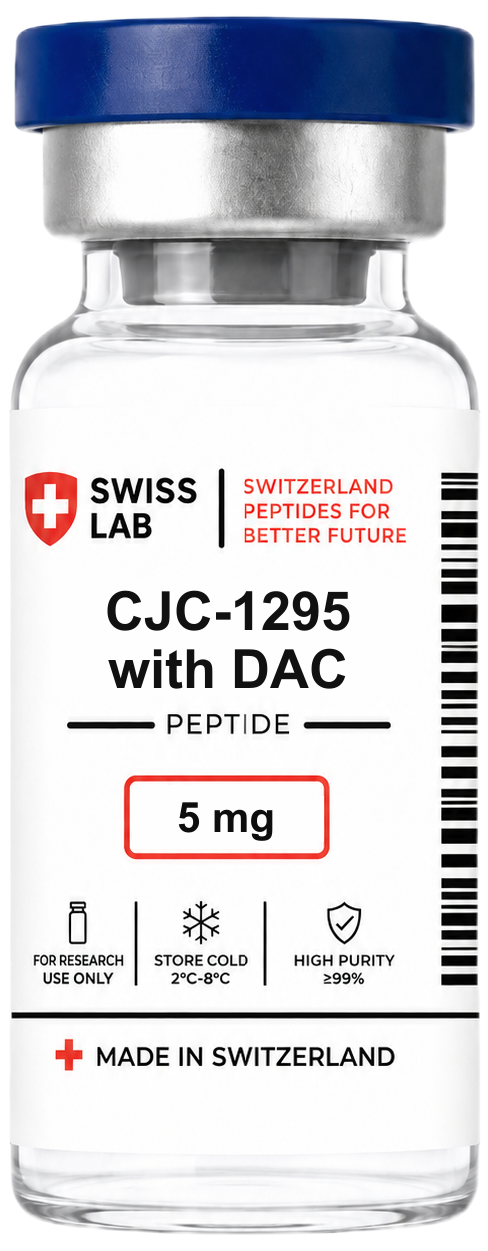
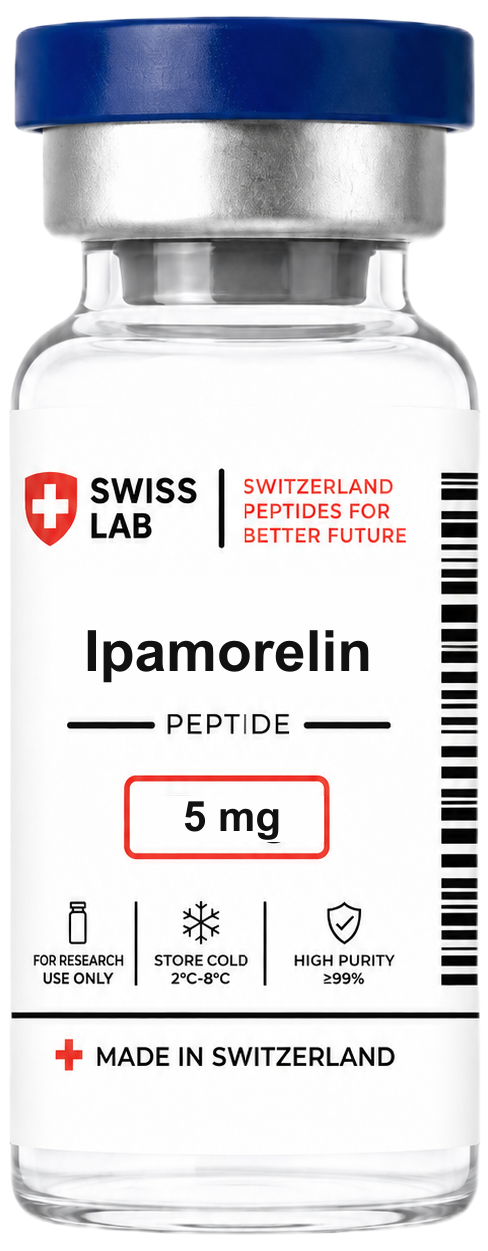
Searches for these two peptides tell a consistent story. Alongside the research literature, people look for them the way they would look for a medicine — by pharmacy, by prescription, by list price. That expectation deserves a direct answer, because it is wrong in a specific and important way, and the correct answer explains most of what anyone sourcing these materials actually needs to know.
What follows is a provenance and documentation guide. It describes how research peptides of this class are manufactured, what analytical paperwork exists for them, and what that paperwork does and does not prove. It describes no use of any kind: both compounds are supplied for laboratory research use only, are not medicines, and nothing here should be read as guidance for use in humans.
- Neither compound is an approved medicine, food or supplement in the EU, US or most jurisdictions, and neither is dispensed by pharmacies — there is no pharmacy price for either.
- Both are produced by solid-phase peptide synthesis, purified by preparative reversed-phase HPLC and lyophilised into sealed vials.
- A purity figure such as 98% is a chromatographic result for one specific batch, not a property of the compound.
- A verifiable supply means batch-linked paperwork: a certificate of analysis, the HPLC trace behind the number, mass-spectrometry identity confirmation, a lot number and a test date.
- Both are supplied for in-vitro laboratory research only and are not for human or veterinary use.
What the two compounds are
CJC-1295 is a modified analogue of growth-hormone-releasing hormone, studied at the GHRH receptor in laboratory and animal models. Ipamorelin is a short synthetic peptide studied as a selective agonist at the ghrelin receptor (GHS-R1a), and is grouped with the growth-hormone secretagogues on that basis. They therefore act at different receptors, which is why they recur together in the endocrine literature; the mechanism side is covered in detail in our separate comparison, “CJC-1295 vs Ipamorelin vs Sermorelin”, and is not repeated here.
Regulatory status: research compounds, not pharmacy products
Neither CJC-1295 nor ipamorelin holds a marketing authorisation as a medicinal product in the European Union, the United States, or most other jurisdictions. Neither is an approved food or dietary supplement. In regulatory terms they sit where any other unapproved research chemical sits: materials supplied to laboratories for in-vitro research, labelled research use only, and not for human or veterinary use. National rules on the import, possession and supply of unapproved substances differ, so anyone sourcing them is responsible for checking the rules that apply where they are.
That is also the direct answer to the question many readers arrive with. Pharmacies dispense authorised medicinal products. Where no authorisation exists there is no product for a pharmacy to stock, no prescription that can be written against it, and consequently no pharmacy price — not a high one, not a low one, none at all. A supplier presenting either compound as though it were a pharmacy medicine, or quoting a figure described as a pharmacy price, is describing a regulatory status that does not exist.
How research peptides of this class are made
Both compounds are chemically synthesised, not extracted from a biological source. The standard method is solid-phase peptide synthesis, in which the chain is assembled while anchored to an insoluble resin bead. It is built one residue at a time, working from the C-terminus: a protected amino acid is coupled to the growing chain with an activating reagent, the temporary protecting group on its amino terminus is removed, and excess reagents are simply washed away before the next residue is added. Anchoring the chain to a solid support is what makes this practical, because purification between steps reduces to filtration and washing.
Once the sequence is complete the peptide is cleaved from the resin and its side-chain protecting groups are removed, usually in a single acid treatment with scavengers present to trap the reactive fragments released. The peptide is then precipitated and collected. What comes out of this stage is crude material, and it is a mixture: every coupling step is slightly less than quantitative, so the crude product contains truncated and deletion sequences alongside the target, plus modified variants and residual reagents. Crude purity is typically well below any figure a specification would later quote.
Purification is therefore the step where quality is won or lost. The crude material is separated by preparative reversed-phase HPLC — the same principle as analytical HPLC, run at scale — with fractions collected across the eluting peak, analysed, and pooled according to how clean each one is. The pooled fractions are lyophilised (freeze-dried) into a sealed vial, generally as a salt with a counter-ion such as acetate or trifluoroacetate. This is where a purity specification comes from, and it is worth being precise about what it means. A figure such as 95% or 98% is a chromatographic result for one specific batch, measured by a named method, expressing the target peak’s area as a fraction of total detected peak area. It is not a property of the compound, not a statement of how many milligrams of peptide are in the vial, and not a claim about identity or about suitability for anything.
The documentation that makes a supply verifiable
The difference between a documented and an undocumented supply is not a matter of presentation. It is whether specific, dated, batch-linked measurements exist for the material in the vial, and whether they are shown. Each document answers a narrow question, and none of them answers the others.
| Document | What it proves | What it does not prove |
|---|---|---|
| Batch-specific certificate of analysis | That the tested batch met the listed specifications on the stated test date | Nothing about a different batch, and nothing about fitness for any use |
| Analytical HPLC chromatogram | That the purity figure has a real trace behind it, and where the impurity peaks fall | The identity of the main peak |
| Mass-spectrometry result | That the measured molecular weight matches the value calculated from the sequence | The proportion of impurities present |
| Batch or lot number | That the paperwork can be tied to the physical vial received | Anything about quality on its own |
| Test date and stated method | When the figure was generated and how it was measured | That the material still meets it after storage and transit |
| Net peptide content | How much of the vial’s mass is peptide rather than water and salts | The sequence purity of that peptide |
Two companion guides go further into this than is useful to repeat here. “How to Read a Peptide COA” walks through a certificate field by field, and “How Peptide Purity Is Measured” covers the analytical methods themselves — how a chromatogram is integrated, why mass spectrometry is a separate check on identity, and why chromatographic purity and net peptide content are two different numbers.
Evaluating a supplier
The questions below are the practical form of everything above. They are deliberately about documents and disclosure rather than about branding, because those are the parts that can be checked before ordering rather than after.
- Is the analysis batch-specific, or is it one generic PDF reused across every product? A certificate with no lot number cannot be matched to what arrives.
- Is the peptide identified by its full sequence and molecular weight, or only by a trade name? Identity is a chemical statement, not a label.
- Is there an analytical trace behind the purity figure, or only the figure? A number with no chromatogram is an assertion.
- Are storage conditions and cold-chain handling specified, both for shipment and for the vial on arrival? Lyophilised peptides are hygroscopic and temperature-sensitive, so handling is part of the specification.
- Is the research-use-only status stated plainly, or is it buried in small print while the surrounding copy implies something else? A supplier describing an unapproved compound in wellness or performance terms is contradicting its own regulatory position.
- Is there an identifiable business behind the site, with a working contact route and someone who answers technical questions? Documentation is only as useful as the ability to query it.
What determines cost
Prices for the same nominal compound vary widely, and most of that spread is explained by a small number of real production factors rather than by margin. Sequence length comes first: each additional residue is another coupling cycle with its own reagent consumption and its own yield loss, so a five-residue peptide and a twenty-nine-residue one are not comparable pieces of work, and these two compounds sit at opposite ends of that range. Difficulty compounds it, because some sequences aggregate on the resin and couple poorly, and non-standard or D-configured residues are more expensive building blocks. Purity grade tells disproportionately, since taking a batch from good to excellent means discarding the fractions that are not quite good enough. Batch scale spreads fixed costs across more vials. Analytical work is a direct cost — every test on a certificate was paid for, which is one reason thoroughly documented material is never the cheapest thing available. So are cold-chain packaging and shipping. Material offered far below what these factors imply is usually cheaper on one of them, and the analysis is the easiest one to leave out.
What the evidence does not establish
Both compounds are heavily marketed, and the marketing bears little resemblance to the literature. The published work on CJC-1295 and ipamorelin is preclinical endocrine research — receptor pharmacology and secretagogue activity in cell and animal models — and it establishes none of the following:
- Any effect on body composition, muscle, fat or physique in humans. This is the most common marketing claim and it is not a finding of the mechanism literature.
- Any effect on recovery, injury healing, sleep or athletic performance in people.
- Any anti-ageing property. Activity at the growth-hormone axis in a research model is not a demonstrated outcome of any kind.
- Human dosing, routes of administration or long-term safety — nor that findings in animal models transfer to humans at all.
The references below point to the primary literature for both compounds and to the methods literature behind the documentation described here. Specifications, batch documentation and pricing belong on the product pages rather than in an article, and are listed there.
Frequently asked questions
- Where do CJC-1295 and Ipamorelin actually come from?
- They are chemically synthesised, not extracted from anything. Both are assembled by solid-phase peptide synthesis, purified by preparative reversed-phase HPLC and freeze-dried into sealed vials, usually as an acetate or trifluoroacetate salt. Purification is the step that decides the purity a batch can be specified at.
- Can CJC-1295 or Ipamorelin be bought from a pharmacy?
- No. Neither holds a marketing authorisation as a medicinal product in the EU, the US or most jurisdictions, so there is no authorised product for a pharmacy to dispense, no prescription that can be written against one, and no pharmacy price. They are supplied to laboratories as research materials only.
- What does a research peptide certificate of analysis actually prove?
- That a named batch met the specifications listed on it when it was tested, by the methods named on it. It is evidence about one batch on one date. It says nothing about a different batch and nothing about suitability for any use.
- What does a purity figure like 98% mean?
- It is normally chromatographic purity by reversed-phase HPLC: the target peak’s area as a percentage of total detected peak area for that batch. It is not the share of the vial’s mass that is peptide — that is net peptide content, a separate and usually lower figure — and it does not confirm identity, which requires mass spectrometry.
- Why do prices for the same compound differ so much?
- Mostly for production reasons: sequence length and synthesis difficulty, the purity grade a batch is taken to, batch scale, how much analytical testing was performed, and cold-chain handling. Full batch documentation is a real cost, so heavily documented material is rarely the cheapest on offer.