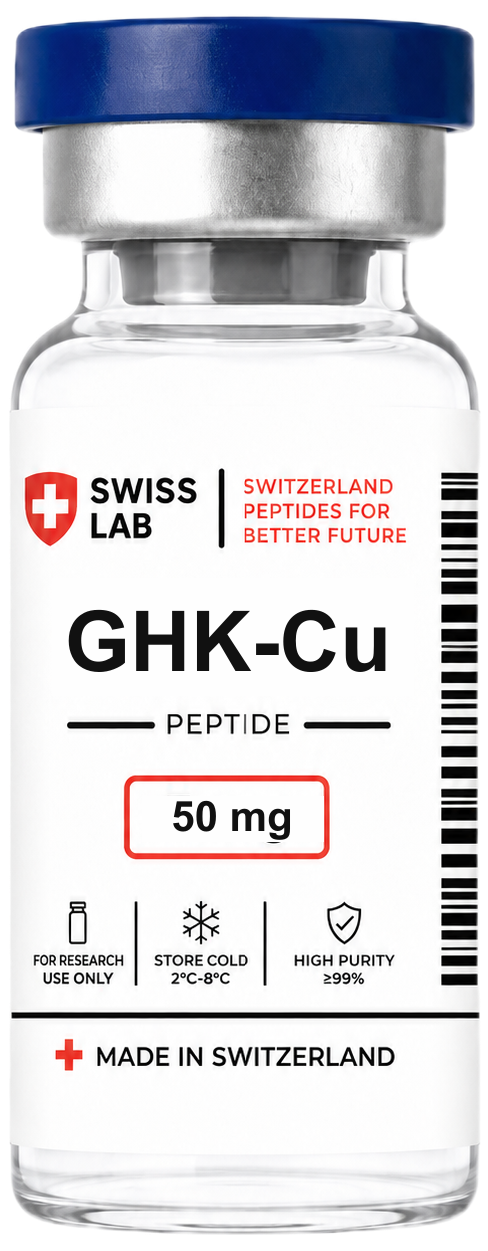
GHK-Cu — the copper complex of the tripeptide glycine-histidine-lysine — is one of the most-studied small peptides in the extracellular-matrix and skin-research literature. It occurs naturally in the body, and a recurring observation in the published work is that its levels decline with age, which is part of why it draws research interest.
This overview summarises how GHK-Cu is described in peer-reviewed laboratory and animal-model studies, for orientation within the research community. It does not describe human use, cosmetic effects, dosing, or therapeutic outcomes, and nothing here should be read as guidance for use in or on humans.
- GHK-Cu is a tripeptide (glycine-histidine-lysine) bound to a copper(II) ion.
- It occurs naturally and is reported in the literature to decline with age.
- It is studied mainly in extracellular-matrix, skin-remodelling and gene-expression research models.
- It is supplied for laboratory research use only and is not approved for human or veterinary use.
What GHK-Cu is
Chemically, GHK is a short sequence of three amino acids — glycine, histidine and lysine — that has a high affinity for copper. When bound to a copper(II) ion it is written GHK-Cu. The copper is not incidental: much of the research interest is specifically in the copper-peptide complex rather than the bare peptide, because the two behave differently in laboratory models.
Mechanisms studied
In the published literature, GHK-Cu is examined mainly for its interaction with the extracellular matrix — the structural scaffolding around cells. Research models have looked at its relationship to collagen and other matrix components, at copper transport, and at broad effects on gene expression. More recent work has catalogued large numbers of genes whose expression shifts in GHK-Cu-treated cell cultures. These are mechanistic observations in laboratory models and should not be read as effects in humans.
Where it appears in research
GHK-Cu turns up across several research areas: skin and tissue-remodelling models, wound-healing research, antioxidant and metal-binding chemistry, and gene-expression profiling. Its appearance in skin-research models in particular is why it is so widely discussed — but appearing in a research model is not the same as a demonstrated outcome, a distinction the next section makes explicit.
What the evidence does not establish
As with most research peptides, the honest summary is that the mechanistic and laboratory work is the well-developed part, and little can be claimed beyond it. The literature does not establish:
- Cosmetic or therapeutic effects in humans — the research is mechanistic and largely preclinical.
- Any outcome from a particular preparation or concentration — these are not within the scope of the published mechanism research.