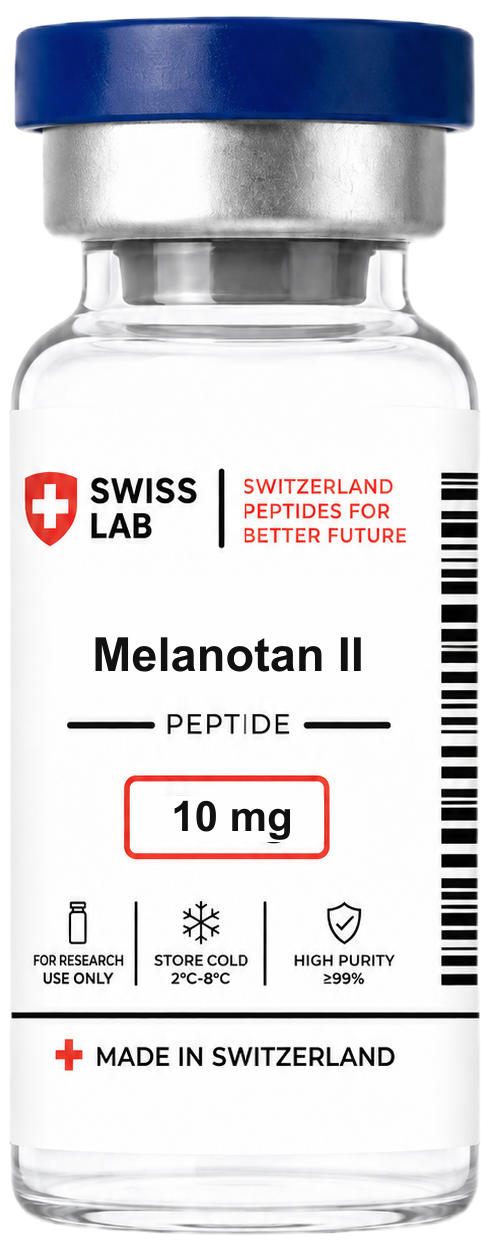
Melanotan II is a synthetic cyclic heptapeptide, built as an analogue of α-melanocyte-stimulating hormone (α-MSH). It is one of the few research peptides whose name is better known from consumer marketing than from the scientific literature it actually belongs to. That literature is melanocortin receptor pharmacology: a small family of G-protein-coupled receptors, a well-characterised second-messenger pathway, and a set of laboratory models that have been used for decades to work out which receptor does what in which tissue. This overview stays inside that literature.
What follows summarises how Melanotan II and the melanocortin receptor system are described in peer-reviewed laboratory and animal-model research, for orientation within the research community. It does not describe human use, cosmetic effects, dosing, administration, or outcomes of any kind. Melanotan II is supplied strictly for laboratory research use. It is not an approved medicine, food, cosmetic or supplement in the EU, the US or any other jurisdiction, it holds no marketing authorisation anywhere, and several national medicines regulators have issued public warnings about unlicensed products sold under the melanotan name. The section below on what the evidence does not establish is the most important part of this page.
- Melanotan II is a synthetic cyclic heptapeptide analogue of α-MSH, closed by a lactam bridge between two side chains.
- It is a non-selective melanocortin receptor agonist. In receptor assays it engages several melanocortin receptors at once rather than a single target, and this drives everything else about its research profile.
- Melanocortin receptors MC1R to MC5R are G-protein-coupled receptors signalling mainly through cAMP; MC1R is the one studied in pigment-cell biology.
- It is not afamelanotide. Afamelanotide is a separate, MC1R-directed analogue with a narrow authorisation for a rare photosensitivity condition; that authorisation does not extend to Melanotan II in any way.
- It has no marketing authorisation in any jurisdiction, medicines regulators have warned against unlicensed melanotan products, and it is supplied for laboratory research use only.
What Melanotan II is, structurally
Melanotan II is a cyclic heptapeptide. It is built around the four-residue core — histidine, phenylalanine, arginine, tryptophan — that runs through the melanocortin family and is generally treated in the literature as the message sequence that melanocortin receptors recognise. Native α-MSH is a 13-residue linear peptide; Melanotan II compresses that pharmacophore into seven residues and closes the sequence into a ring through a lactam bridge formed between two amino-acid side chains, one carrying a carboxyl group and one an amine. Two further substitutions are standard melanocortin-analogue design choices: the phenylalanine is present in its D-form rather than the natural L-form, which increases resistance to enzymatic cleavage and potency at the receptor, and a norleucine residue replaces the methionine of the native sequence, removing a side chain that is prone to oxidation. The result is a considerably more metabolically stable molecule than native α-MSH, which is the whole point of the design.
The single most important pharmacological fact about Melanotan II is that it is not selective. Native α-MSH is itself promiscuous across most of the melanocortin receptor family, and the cyclisation strategy that produced Melanotan II raised potency without narrowing the target. In receptor-binding and functional assays it behaves as an agonist at several melanocortin receptors simultaneously. Everything else in its research profile follows from that: the breadth of tissue systems it turns up in, the difficulty of attributing any single observation to any single receptor, and the fact that off-target activity is the recurring theme of the literature rather than a footnote to it.
The melanocortin receptor family: MC1R to MC5R
The melanocortin receptors, MC1R through MC5R, are class A (rhodopsin-like) G-protein-coupled receptors. The canonical signalling route described for all five is the same: agonist binding shifts the receptor conformation, the receptor couples to a stimulatory G protein, adenylyl cyclase is activated, and intracellular cyclic AMP rises, with protein kinase A and downstream transcriptional machinery as the usual readouts in cell work. cAMP accumulation in a transfected cell line is in practice the standard functional assay for a melanocortin agonist, and most potency figures quoted for compounds in this class come from exactly that kind of experiment. The five receptors differ far less in how they signal than in where they are expressed, which is why the tissue column below carries most of the information.
| Receptor | Tissue association in the literature | Research context |
|---|---|---|
| MC1R | Melanocytes; also reported on some immune cell types | Pigment-cell biology; melanin-synthesis signalling in cell and animal models |
| MC2R | Adrenal cortex; requires the MRAP accessory protein for surface expression | The ACTH receptor. It is selectively activated by ACTH rather than by α-MSH-type ligands, which sets it apart from the rest of the family |
| MC3R | Hypothalamus and other central sites; also reported peripherally | Central energy-balance research and inflammation signalling in rodent models |
| MC4R | Predominantly central nervous system, notably hypothalamic nuclei | Central energy-balance research; a long-standing subject of rodent genetics |
| MC5R | Exocrine tissues, including sebaceous and lacrimal glands in animal models | Exocrine-gland research |
Because Melanotan II is non-selective, it engages several of these receptors at the same time in research models. MC2R is the standing exception across this analogue class, since it responds to ACTH rather than to α-MSH-derived ligands. Non-selectivity is precisely why the Melanotan II literature is scattered across pigment-cell biology, central energy-balance research and exocrine-tissue research at once, and why off-target activity is the recurring caveat in that literature: a ligand that engages four receptors across four different tissue systems cannot be characterised by looking at any one of them in isolation. Research groups working on this family have generally treated Melanotan II as a broad-spectrum pharmacological tool and have moved toward receptor-selective analogues when they wanted to attribute an effect to a specific receptor.
MC1R and pigment-cell biology in laboratory models
MC1R is the melanocortin receptor studied in pigment-cell biology, and the model systems are old and well characterised. In melanocyte cell culture, MC1R activation raises intracellular cAMP, and that rise is studied in relation to the transcription factor MITF and to the expression of tyrosinase and related enzymes of the melanin-synthesis pathway. The observation that recurs across this work is a shift in the balance between the two melanin types the pathway can produce, toward eumelanin and away from pheomelanin. In mice, the same receptor sits at the centre of classical coat-colour genetics: agouti signalling protein acts as an endogenous antagonist at MC1R, and loss-of-function and gain-of-function receptor variants produce the coat-colour phenotypes that made this system a textbook example of G-protein-coupled receptor biology long before any analogue was marketed to anybody. All of this is cell-culture and animal-model work. It describes a signalling pathway. It does not describe an outcome in a person, and nothing in it supports the claims attached to consumer products.
Melanotan II is not afamelanotide
The word “melanotan” covers two different molecules, and conflating them is the most common error in consumer-facing material about this compound. Melanotan I is the informal name for afamelanotide, a linear 13-residue α-MSH analogue directed at MC1R. Afamelanotide went through formal clinical development and holds a marketing authorisation, in the European Union and in the United States, for erythropoietic protoporphyria, a rare inherited photosensitivity condition. It is a prescription medicine with a defined and narrow indication, an assessed safety profile, a named manufacturer and a regulated supply chain.
Melanotan II has none of that. It is a different molecule — shorter, cyclic, and non-selective rather than MC1R-directed — it has never completed clinical development, and it holds no marketing authorisation in any jurisdiction. The existence of an authorised MC1R-directed medicine says nothing whatsoever about Melanotan II, and nothing about products sold online under the melanotan name. Treating “melanotan” as a single consumer category is exactly the confusion that regulator warnings have had to address, and it is worth being explicit: no authorisation held by afamelanotide extends to Melanotan II, to any product containing it, or to any claim made about it.
What the evidence does not establish, and why regulators have warned
This is the section that matters. Melanotan II is one of the most aggressively marketed compounds that appears in peptide catalogues, and the marketing is not a mild exaggeration of the research the way it sometimes is elsewhere: it asserts outcomes that the published literature does not establish for any human use, for a compound that no regulator has assessed. Products sold under the melanotan name are promoted with claims about skin tanning and about sexual function. Neither claim is established by the research literature for this compound in people, and neither has been evaluated by any medicines authority in a product bearing this name. Specifically, the evidence does not establish:
- Any tanning, pigmentation or cosmetic outcome in people. The pigment-cell work is melanocyte cell culture and animal coat-colour genetics, and describing a cAMP-driven signalling pathway in those systems is not the same as demonstrating an outcome in a human being.
- Any effect on sexual function. This is a marketing claim attached to unlicensed products, not a conclusion the melanocortin literature supports for this compound in humans.
- Any effect on appetite, body weight or energy balance in people. The MC3R and MC4R work is rodent genetics and central-signalling research and does not translate into a human claim.
- Human dosing, routes of administration, safety or tolerability. None of this is established, no regulator has assessed a Melanotan II product, and non-selective agonism at several receptor subtypes is the opposite of a well-characterised safety profile.
- That products sold to consumers contain what their labels say. Regulator communications and published analyses have described unlicensed melanotan products of uncertain identity, purity and composition.
The regulatory position is unusually clear for a research peptide. The UK Medicines and Healthcare products Regulatory Agency has issued public warnings about unlicensed melanotan products sold to consumers, and medicines agencies in a number of EU and EEA countries have done the same. The common thread in those communications is not a dispute about a specific finding, it is the absence of any evaluation at all: an unlicensed product has no assessed safety profile, no quality standard behind it, no verified composition, and no regulator standing behind any statement made about it. The published literature also contains case reports associated with the use of unlicensed melanotan products, which is one of the reasons the warnings exist. Nothing in that picture is compatible with consumer use, and none of it is what this compound is supplied for.
Laboratory handling, identity and purity
Melanotan II is supplied as a lyophilised (freeze-dried) powder, and the dry solid in a sealed vial is by a wide margin its most stable form. The cyclic structure is a stability feature rather than a formality: a constrained lactam ring is generally less exposed to exopeptidase attack than an equivalent linear sequence, which is part of why the molecule was designed this way. Cyclisation does not, however, protect against the two things that most often degrade a peptide on the bench, which are oxidation and light. Melanotan II contains a tryptophan residue, and tryptophan-containing peptides are worth handling in amber or foil-wrapped vessels rather than under ambient laboratory light.
- Sealed lyophilised vials are held frozen for long-term storage and refrigerated for shorter periods, protected from light and moisture.
- Repeated warming and cooling of a sealed vial invites condensation, which is a common and avoidable cause of degradation in dry peptide stocks.
- Reconstituted solutions are considerably less stable than the dry powder. The working assumption in the literature is short-term refrigerated storage rather than open-ended storage.
- Aliquoting at the point of reconstitution avoids repeatedly freezing and thawing a single stock, and the general reconstitution and storage guidance published on this site applies here without modification.
For a compound with this much unregulated supply around it, analytical documentation is the only thing that distinguishes one vial from another. Two measurements carry the weight for any batch: an identity confirmation, normally by mass spectrometry against the expected molecular mass, and a purity figure, normally by reversed-phase HPLC with the chromatogram attached rather than a bare percentage. For a cyclic peptide the identity check deserves particular attention, because lactam formation eliminates a molecule of water and the cyclised product therefore differs in mass from its linear precursor. An incompletely cyclised batch is a real synthesis failure mode, and it is visible in the mass data to anyone who reads it. Our separate guide, “How to Read a Peptide Certificate of Analysis (COA)”, walks through that document field by field. The product page below lists the analytical documentation available for the batch.
Frequently asked questions
- What is Melanotan II?
- A synthetic cyclic heptapeptide analogue of α-melanocyte-stimulating hormone, closed by a lactam bridge and engineered for metabolic stability relative to the native hormone. In receptor pharmacology it is described as a non-selective melanocortin receptor agonist. It is supplied for laboratory research use only.
- What does “non-selective melanocortin receptor agonist” mean?
- It means the compound activates several members of the melanocortin receptor family rather than one. That breadth is why its research profile spans pigment-cell, central energy-balance and exocrine-tissue models simultaneously, and why off-target activity is the recurring caveat in the literature.
- Why do regulators warn about melanotan products sold online?
- Because those products are unlicensed. They hold no marketing authorisation, have no assessed safety profile or quality standard, and regulator communications and published analyses have described products of uncertain identity, purity and composition. The UK MHRA and agencies across the EU and EEA have issued public warnings.
- Is Melanotan II the same as afamelanotide (Melanotan I)?
- No. Afamelanotide is a different molecule — a linear 13-residue MC1R-directed analogue — that completed clinical development and holds a narrow authorisation for a rare photosensitivity condition. That authorisation does not extend to Melanotan II, which is a shorter, cyclic, non-selective compound with no authorisation anywhere.
- What should be checked when sourcing Melanotan II for a laboratory?
- A batch-specific certificate of analysis: identity by mass spectrometry against the expected mass, purity by reversed-phase HPLC with the chromatogram shown, and traceable batch identification. For a cyclic peptide the mass data also indicate whether cyclisation went to completion.