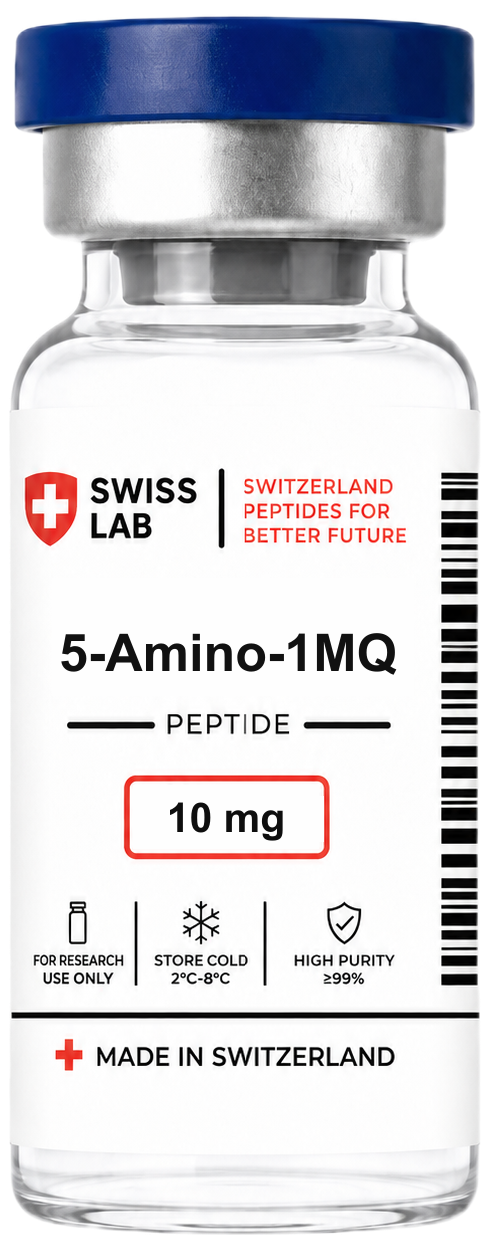
5-Amino-1MQ is catalogued beside the peptides and is not one. It is a small molecule — a quinolinium salt of 286.11 g/mol, next to compounds that run from about a thousand to twenty-two thousand. Nothing about it is a chain of amino acids, and the analytical habits that suit a peptide do not transfer to it unchanged.
The part worth knowing before buying is simpler than any of that, and it is arithmetic anyone can check against the formula printed on the product page.
- Supplied as the iodide salt: C10H11IN2, 286.11 g/mol, CAS 42464-96-0 (PubChem CID 66522933).
- The active part is the cation alone: C10H11N2+, 159.21 g/mol (PubChem CID 950107).
- Iodide is therefore 126.90 of 286.11 — 44.4% of the mass in the vial.
- A 100 mg vial of the iodide holds about 55.6 mg of the cation.
- It targets NNMT, nicotinamide N-methyltransferase (UniProt P40261) — an enzyme, not a receptor.
Nearly half the weight is the counter-ion
The molecule carries a permanent positive charge. Its nitrogen is quaternised — methylated, with no lone pair left to give away — so unlike an ordinary amine it cannot be neutral at any pH. A permanently charged cation cannot be isolated on its own; something negative has to come with it, and here that something is iodide, left behind by the methyl iodide used to put the methyl group on in the first place.
Iodine is heavy. A single iodide ion weighs 126.90 g/mol against a cation of 159.21, so the salt is 286.11 and the counter-ion accounts for 44.4% of it. Acetate on a peptide is a different order of thing entirely — worth putting side by side, with a named example rather than a vague average, because the peptide figure varies with how many basic side chains the sequence has.
| 5-Amino-1MQ | LL-37 with six acetates | NAD+ | |
|---|---|---|---|
| What it is | Quinolinium salt | Peptide + counter-ions | Dinucleotide |
| Active part (g/mol) | 159.21 | 4,493.3 | 663.4 |
| Counter-ion | Iodide, 126.90 | Acetate, 59.04 each | None |
| Mass in the vial (g/mol) | 286.11 | 4,847 | 663.4 |
| Counter-ion share of mass | 44.4% | 7.3% | 0% |
| Active part per 100 mg | about 55.6 mg | about 92.7 mg | 100 mg |
None of this is a fault, and it is not hidden — the iodide is in the molecular formula and in the name, and a supplier quoting C10H11IN2 and 286.11 has told you exactly what is in the jar. But a reader who skips from the name to the milligrams will assume the number refers to the active cation, and here that assumption is wrong by nearly half.