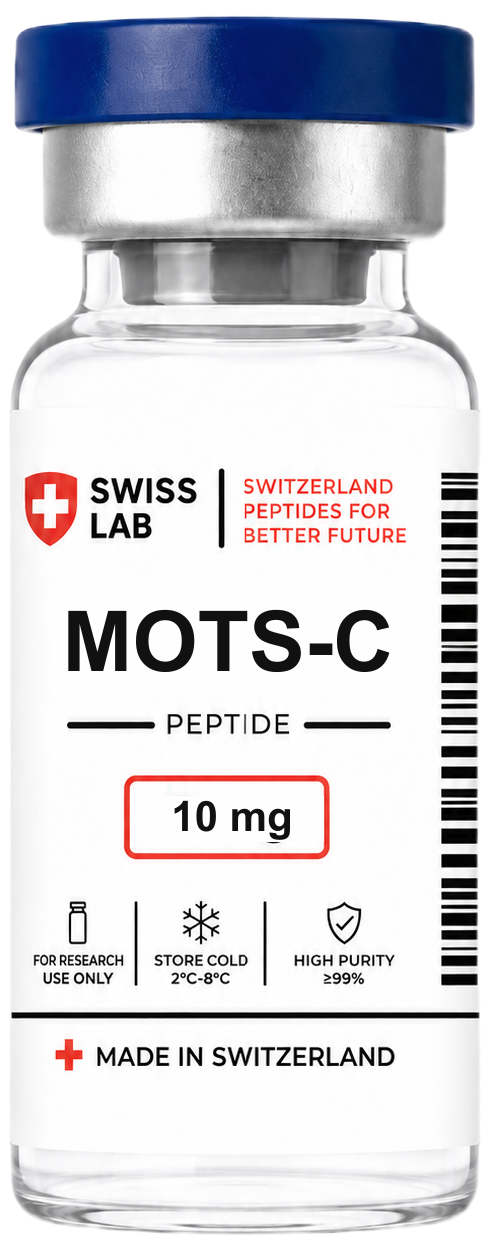
MOTS-c is unusual in this catalogue before you reach any chemistry: it is not encoded in nuclear DNA. The sequence sits inside the mitochondrial genome, within the gene for the 12S ribosomal RNA, and the name is simply a description of that address — Mitochondrial ORF of the Twelve-S rRNA, type c. It was identified and reported in Cell Metabolism in 2015.
The practical half of the page is shorter and more useful. The peptide is sixteen residues and 2,174.6 g/mol, and two of those residues are methionine. That single fact governs what its certificate has to separate and how the powder should be kept.
- MRWQEMGYIFYPRKLR — 16 residues, 2,174.6 g/mol, CAS 1627580-64-6.
- Molecular formula C101H152N28O22S2; the two sulfurs are the two methionines, at positions 1 and 6.
- Two methionines means three oxidised species, not one: +16 at either, +32 at both.
- Tryptophan at position 3 and tyrosines at 8 and 11 give it real absorbance at 280 nm — most short peptides have none.
- Encoded within the mitochondrial 12S rRNA gene rather than in nuclear DNA.
What the name says
Peptide names are usually opaque. This one is not: it spells out where the open reading frame sits. The mitochondrion carries its own small circular genome, and the 12S ribosomal RNA gene is one of its features; the MOTS-c reading frame lies inside that gene. Reading a peptide out of a gene for a structural RNA is the reason the finding was notable at all, and it is why the compound is described in the literature as a mitochondrial-derived peptide rather than simply as a peptide.
For a buyer the consequence is narrow but real: this is a defined 16-residue sequence with a CAS number, made by synthesis like everything else here. The origin story explains the name, not the manufacturing.
The sequence, and what is in it
Written out: Met-Arg-Trp-Gln-Glu-Met-Gly-Tyr-Ile-Phe-Tyr-Pro-Arg-Lys-Leu-Arg. Four of the sixteen positions are worth naming individually, because each one shows up either in an assay or on a stability report.
| Position | Residue | Why it matters |
|---|---|---|
| 1 and 6 | Methionine | Oxidises to the sulfoxide, adding 16 g/mol each; two of them give three distinct oxidised species |
| 3 | Tryptophan | Also oxidation-prone, and the strongest ultraviolet chromophore in the molecule |
| 8 and 11 | Tyrosine | Absorb at 280 nm alongside the tryptophan |
| 2, 13, 14, 16 | Arg, Arg, Lys, Arg | Four basic side chains — the sites an acetate or trifluoroacetate counter-ion occupies |