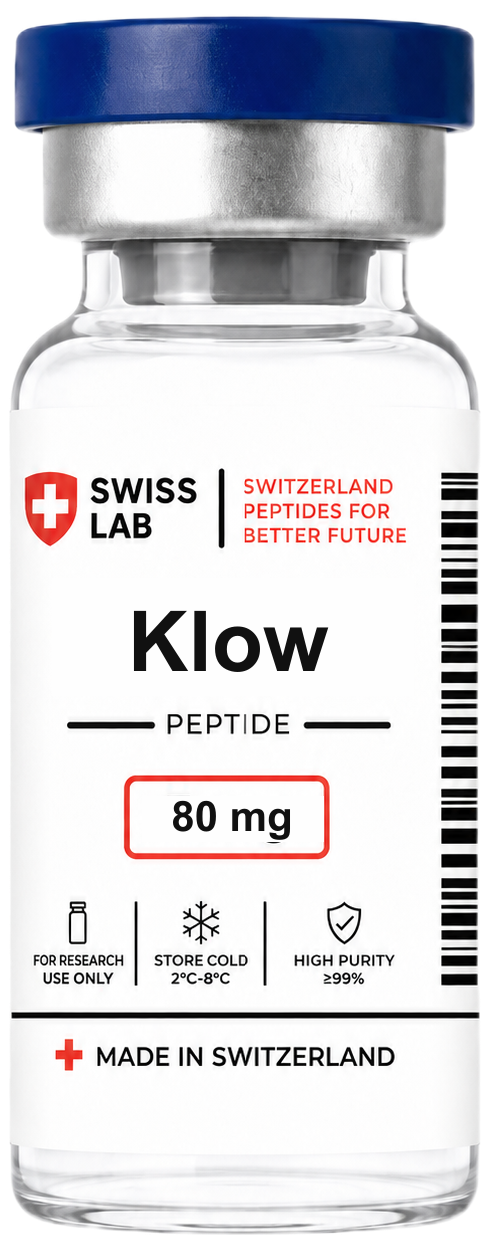
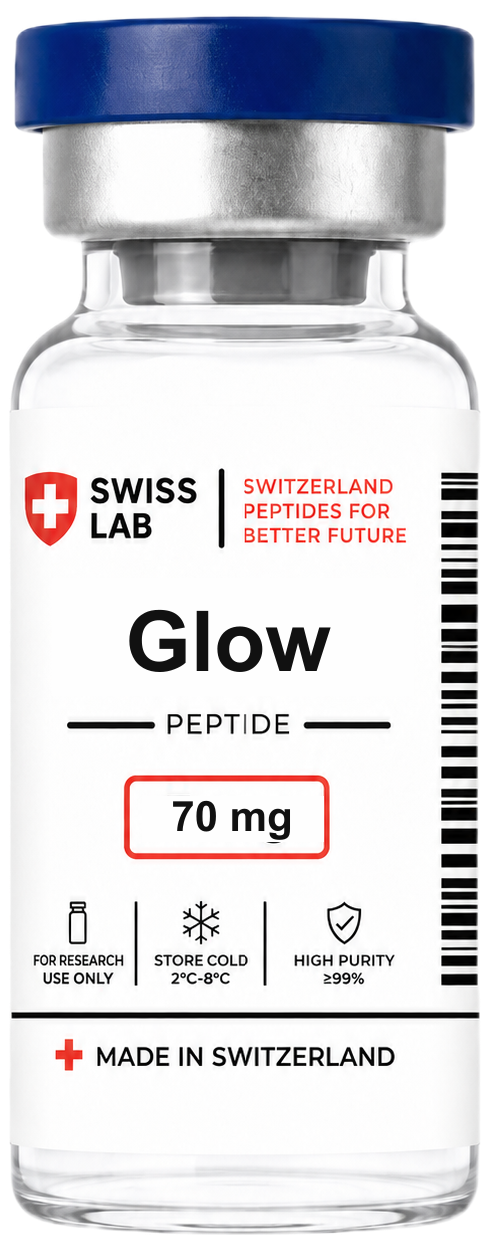
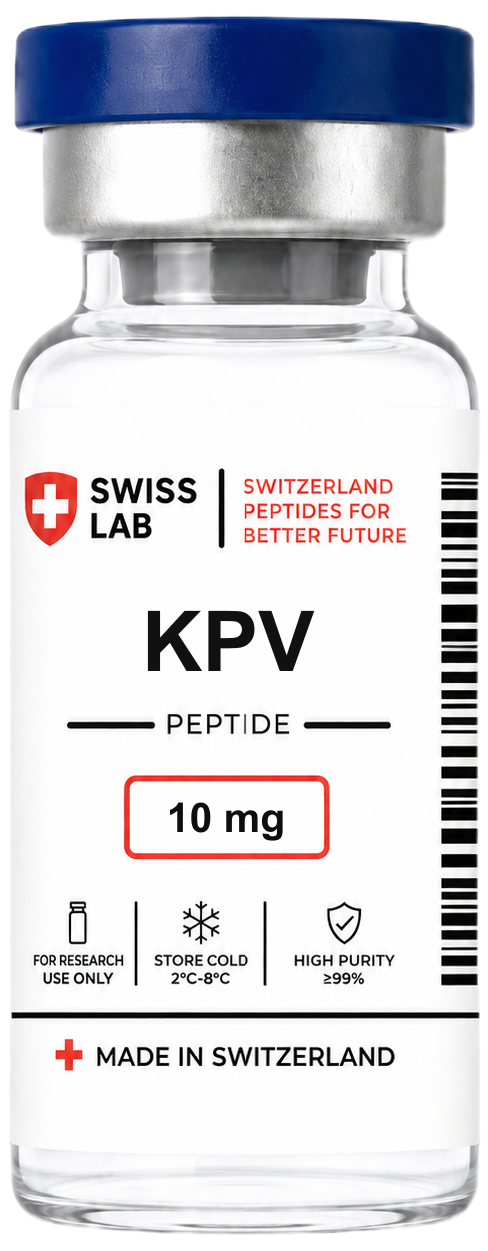
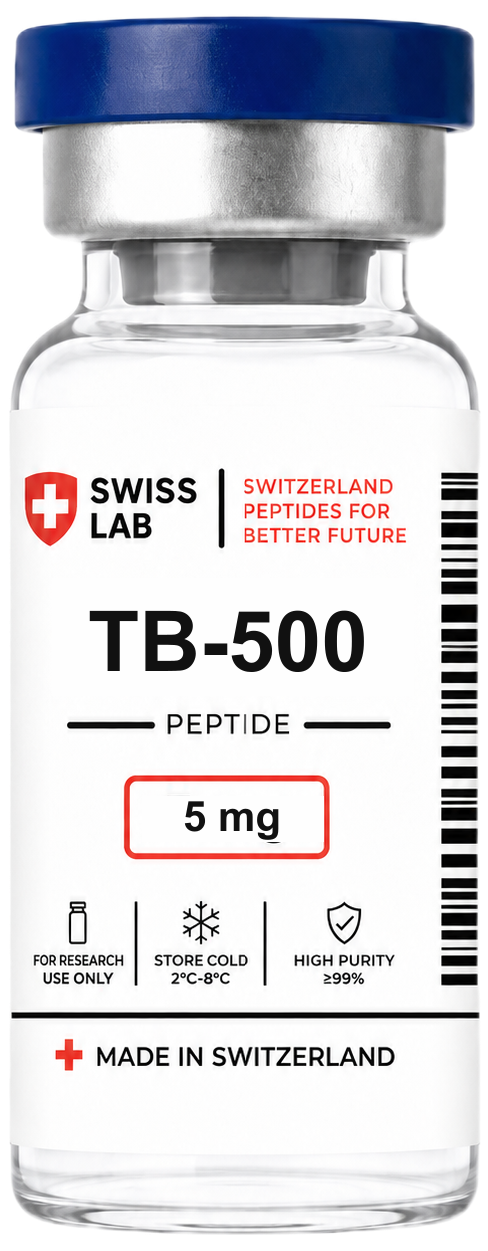
Every single-compound page in this catalogue carries a CAS number and a molecular formula. The KLOW page carries neither, and that is not an omission. KLOW is four compounds in one vial — GHK-Cu, BPC-157, TB-500 and KPV — and a CAS Registry Number names one substance while a molecular formula describes one molecule. Four compounds have four of each, so the page lists a composition instead.
The consequence worth understanding is analytical rather than administrative. Those four span 342.4 to 4,963.4 g/mol, a factor of 14.5, and the instruments that produce a purity figure do not treat a three-residue peptide and a 43-residue one alike. A certificate for a blend can still be informative, but not in the shape most buyers expect.
- KLOW = GHK-Cu · BPC-157 · TB-500 · KPV. It is the GLOW blend with KPV added, and the K is KPV's.
- Component masses: KPV 342.4, GHK-Cu 403.9, BPC-157 1,419.5, TB-500 4,963.4 g/mol — a 14.5-fold spread.
- No CAS number and no molecular formula, because those identify a single substance and this is not one.
- Exactly one sulfur atom across all four molecules: the methionine at position 6 of TB-500.
- Mix equal masses and the molar ratio is roughly 14.5 : 12.3 : 3.5 : 1 (KPV : GHK-Cu : BPC-157 : TB-500), nothing like one-to-one.
- A useful certificate identifies each component separately and states the ratio. A single percentage does neither.
Four compounds, four registry numbers
Three of the four are ordinary peptides of very different lengths. The fourth is not a plain peptide at all — it is a tripeptide carrying a copper(II) ion, which makes it a coordination complex and a different analytical problem from its neighbours.
| Component | Residues | Formula | Mass (g/mol) | CAS |
|---|---|---|---|---|
| KPV | 3 | C16H30N4O4 | 342.4 | 67727-97-3 |
| GHK-Cu | 3 + Cu²⁺ | C14H24N6O4·Cu | 403.9 | 89030-95-5 |
| BPC-157 | 15 | C62H98N16O22 | 1,419.5 | 137525-51-0 |
| TB-500 | 43 | C212H350N56O78S | 4,963.4 | 77591-33-4 |
The blend itself gets no row. There is no registry number for a mixture and no formula that describes one, and inventing either would be the kind of specification that looks authoritative and means nothing. The honest field for a blend is its composition, which is what the product page shows.
Why peak area is not mass
Purity by HPLC is usually reported as area percent: the detector traces a signal, the peaks are integrated, and each peak's share of the total area is quoted. For a single compound that is a reasonable proxy for composition. For a mixture of four it quietly stops being one, because area depends on how strongly each component absorbs, not on how much of it is present.
Peptides are normally detected near 214 nm, where the absorbing group is the peptide bond itself. The signal from a component therefore scales with how many peptide bonds it contains. TB-500 has 42 peptide bonds across 4,963 g/mol — one bond for every 118 g. KPV has 2 across 342 g/mol — one for every 171 g. Equal masses of the two present about 1.45 times as many absorbing bonds for TB-500, and produce correspondingly unequal peaks. The area ratio is not the mass ratio.
Retention is the second half of the problem. KPV is three residues and 342 g/mol, and its lysine carries a positive charge under the acidic conditions of a normal peptide gradient. A peptide that small offers very little hydrophobic surface to retain it, so it elutes very early on a reverse-phase gradient — close to the void volume, where the solvent front and small-molecule impurities also sit. TB-500 is 43 residues and elutes far later. A gradient chosen to resolve the large component well can leave the small one unresolved at the front of the run, and a peak that is not resolved is not measured.
The component that is not a plain peptide
GHK-Cu is glycyl-histidyl-lysine with a copper(II) ion bound to it. That has one convenient consequence and one inconvenient one.
The convenient one is identification. Copper occurs as two stable isotopes, copper-63 and copper-65, in an abundance of roughly 69 to 31. Anything containing one copper atom therefore shows a characteristic pair of mass-spectrum peaks two units apart in that ratio — a signature that is hard to mistake and easy to look for when you want to confirm that the copper component is present at all.
The inconvenient one is that copper(II) is redox-active, and this blend contains exactly one oxidisable sulfur: the methionine at position 6 of TB-500. Methionine oxidation is the best-characterised covalent change these peptides undergo, it adds 16 g/mol, and transition-metal ions catalyse it. Putting a copper complex and a methionine-bearing peptide in the same vial creates a pathway that neither has on its own. Whether it matters for a given batch is a question for that batch's analysis — precisely the sort of question a blend certificate ought to answer and a single purity figure cannot.
By mass or by mole
A blend is made by weighing, so a stated ratio is a mass ratio. Because the components differ so much in size, the molar picture looks nothing like it. Take equal masses of all four: relative to TB-500 there are about 14.5 times as many KPV molecules, 12.3 times as many GHK-Cu, and 3.5 times as many BPC-157. A vial described as holding four things in equal amounts holds, molecule for molecule, overwhelmingly the two small ones.
Neither way of stating it is wrong, but they are different statements, and a certificate that gives a ratio without saying which one it means has not said much. The same applies to the total: a blend quoted as a single milligram figure is quoting the sum, and the sum does not tell you the split.
What a blend certificate can and cannot establish
What it can do is identify each component and quantify it. Mass spectrometry answers identity component by component — four expected masses, four found, plus the copper isotope pattern for GHK-Cu. Quantification needs a reference standard for each component and a method that resolves all four, after which the ratio can be stated as a measurement rather than as the recipe that was intended.
| Question | Single compound | Four-component blend |
|---|---|---|
| Is it the right molecule? | One mass to confirm | Four masses to confirm separately |
| How pure is it? | Area percent is a fair proxy | Area percent mixes four detection responses |
| What is the ratio? | Not applicable | Needs a reference standard for each component |
| What does one number mean? | Purity of the compound | Depends entirely on what was integrated |
What it cannot do is compress that into one number. A blend quoted at a single purity percentage is reporting one of several different things — the purity each component had before mixing, or the share of total peak area falling under the four expected peaks, or something else again — and those are not interchangeable. The question to ask of such a figure is not whether it is high, but what was measured to produce it.
Frequently asked questions
- Why does the KLOW page have no CAS number or molecular formula?
- Because both identify a single substance and KLOW is four: GHK-Cu, BPC-157, TB-500 and KPV. Each has its own CAS number and its own formula. A blend is described by composition instead, and a registry number invented for a mixture would be meaningless.
- What is the difference between KLOW and GLOW?
- One component. GLOW is GHK-Cu, BPC-157 and TB-500. KLOW is the same three plus KPV, a three-residue peptide of 342.4 g/mol. Both names are trade names, and neither states the ratio.
- Can a blend have a purity percentage?
- It can carry one, but it means something different from a single compound's. Area percent at 214 nm depends on how many peptide bonds each component has, so equal masses do not give equal peaks — TB-500 presents about 1.45 times as many absorbing bonds per gram as KPV. A figure for a blend is interpretable only if the certificate says what was integrated.
- What should a certificate for a four-component blend show?
- Identity for each component separately, normally by mass spectrometry, and a ratio measured against a reference standard for each. For this blend the copper isotope pattern of GHK-Cu is a useful confirmation, and the single methionine in TB-500 is the one site where an oxidised species could appear.