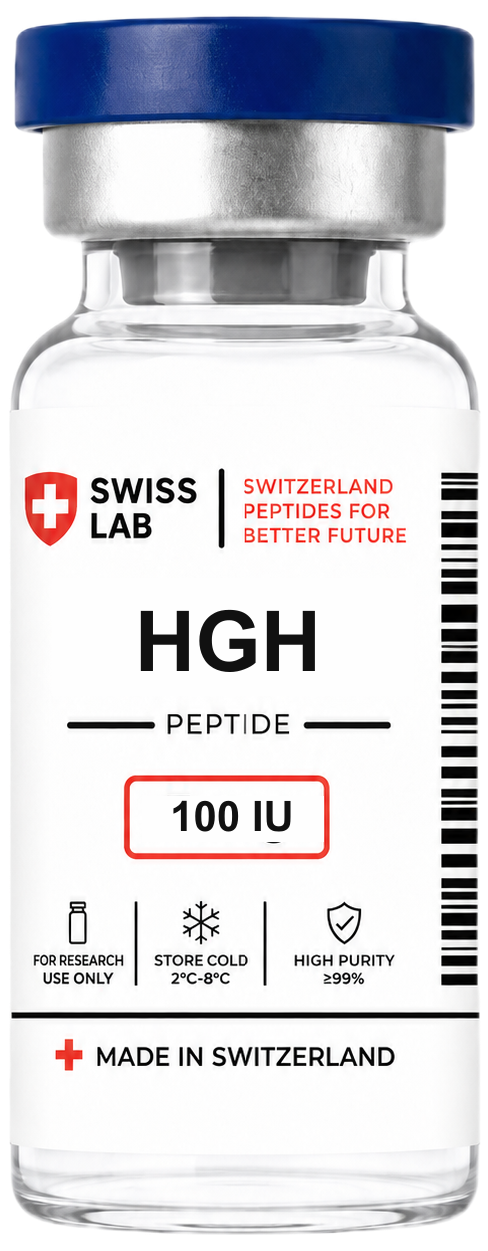
Human growth hormone is listed beside the peptides and is not one. Somatropin is a protein of 191 amino acids and 22,124 g/mol — five times the mass of the largest peptide in this catalogue and twenty-two times that of oxytocin. That difference is not a technicality about vocabulary. It changes what the two standard tests on a certificate of analysis can establish.
A nine-residue peptide is small enough that an accurate mass and a single chromatographic peak between them come close to settling the question of what is in the vial. A 22 kDa protein is not. The same two lines on the certificate answer a narrower question, and the gap between what they say and what a reader assumes they say is the reason this page exists.
- 191 residues, 22,124 g/mol, CAS 12629-01-5, molecular formula C990H1528N262O300S7.
- Made as a 217-residue precursor; the mature chain is residues 27–217 once the 26-residue signal peptide is removed (UniProt P01241).
- Two disulfide bridges, Cys53–Cys165 and Cys182–Cys189 in mature numbering — folding, not sequence, holds that shape.
- The 192-residue variant is a real and older molecule, not a marketing number: it carries an extra N-terminal methionine and about 131 g/mol more.
- The molecule is an authorised medicine in the EU and the US under many brand names; research-grade material is a different regulatory object.
What the molecule is
The gene product is a 217-residue precursor weighing 24,847 g/mol. A 26-residue signal peptide is cleaved during secretion, leaving the mature hormone: residues 27 to 217 of that precursor, 191 residues, 22,124 g/mol. UniProt catalogues it as P01241, SOMA_HUMAN, and the CAS registry number of the recombinant product is 12629-01-5.
It carries exactly two disulfide bridges. In the numbering of the mature chain they join Cys53 to Cys165 and Cys182 to Cys189 — the first closing a large loop across most of the molecule, the second a short one near the C-terminus. That matters for a practical reason: a sequence can be read from a mass spectrum, and a fold cannot. Two preparations with identical sequence and identical mass can differ in whether those bridges are correctly paired.
191 residues, not 192
Listings often specify "191aa", and the number is doing real work rather than decorating the label. The first recombinant growth hormone, produced in E. coli in the early 1980s, kept the N-terminal methionine that bacterial translation begins with. That molecule — somatrem — is 192 residues, one more than the human sequence, and about 131 g/mol heavier.
Modern somatropin is the 191-residue sequence, identical to the pituitary hormone, with no extra methionine. The distinction is therefore checkable rather than rhetorical: it is a mass difference an intact-mass measurement resolves without difficulty, given an instrument that can weigh a 22 kDa protein at all.
Why it is made rather than extracted
Before recombinant expression, growth hormone was extracted from the pituitary glands of cadavers. Those preparations were withdrawn in 1985 after Creutzfeldt–Jakob disease was linked to them; prion strains from French and UK recipients have since been characterised in the literature, and the consequences of those batches are still being studied — a 2024 report in Nature Medicine describes amyloid-β pathology in recipients decades later.
That history is why the recombinant route exists at all, and it is the reason the source of the material is a question worth asking of any supplier of any protein. It is stated here as manufacturing and regulatory history. Nothing in it describes or recommends any use.
What a certificate can and cannot establish
Two tests appear on nearly every certificate in this catalogue: purity by HPLC and identity by mass spectrometry. Both mean something different at 22 kDa than at 1 kDa.
| Oxytocin | MOTS-c | LL-37 | IGF-1 LR3 | HGH | |
|---|---|---|---|---|---|
| Residues | 9 | 16 | 37 | 83 | 191 |
| Mass (g/mol) | 1,007.2 | 2,174.6 | 4,493.3 | 9,117.6 | 22,124 |
| Disulfide bridges | 1 | 0 | 0 | 3 | 2 |
On HPLC, a peptide's close relatives — a deletion sequence, an oxidised methionine — shift retention enough to separate. On a protein five times the size, a single deamidated residue changes about 1 g/mol in 22,124 and may not resolve from the main peak at all. A high area percentage is consistent with a well-made protein; it is much weaker evidence than the same number on a nonapeptide.
On mass spectrometry, weighing an intact 22 kDa protein is a different measurement from weighing a 1 kDa peptide — different instrumentation, different resolution, and a mass envelope rather than a sharp line. And neither test sees folding. The disulfide pairing, the higher-order structure, the fraction present as dimer: none of that is visible in a purity percentage or an intact mass.
That is not an argument that the tests are worthless. It is an argument for reading them as what they are. For a protein, the questions worth asking are which method established the mass, whether related impurities were separated by a method capable of separating them, and whether aggregate content was measured at all — that last one by size-exclusion chromatography, which is a different run from the purity assay.
Regulatory status, stated plainly
Somatropin is an authorised medicinal product in the European Union and the United States, marketed under many brand names. That is a statement of regulatory fact and it makes the distinction sharper rather than softer: a licensed product is manufactured to a pharmacopoeial specification, released by a qualified person and accompanied by an approved label. Research-grade material of the same sequence is a different regulatory object and is not that product.
The comparison to draw is with the other compounds here whose molecules are also authorised medicines somewhere — bremelanotide as Vyleesi, semaglutide as Ozempic, thymalfasin as Zadaxin in some jurisdictions. Same molecule, different object. Sixteen of the compounds in this catalogue fall into that group, and pretending otherwise would be both false and easy to disprove.
The two compounds nearest to it here
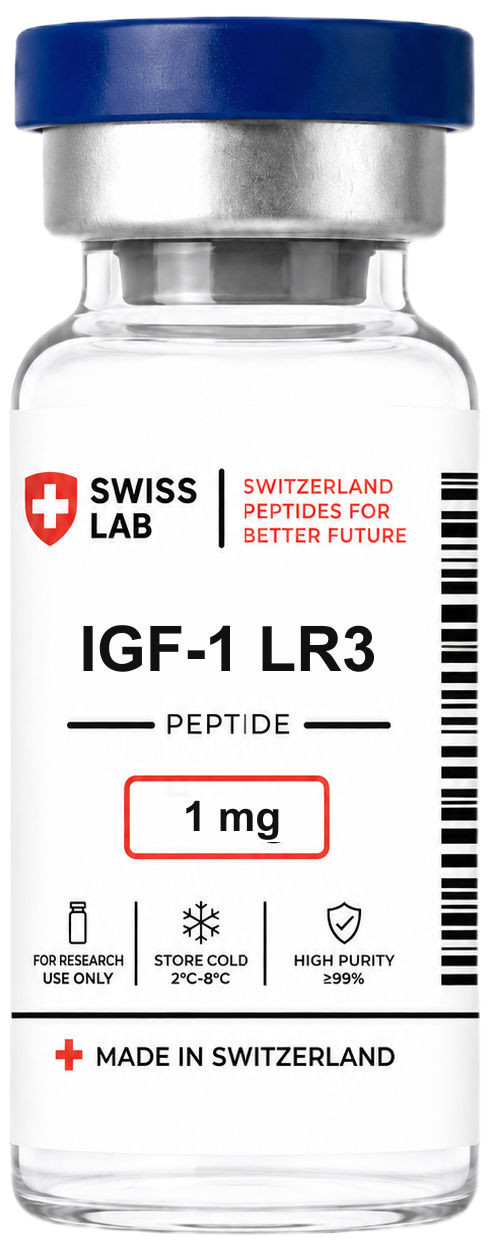
IGF-1 LR3 is the catalogue's other protein rather than peptide: 83 residues, 9,117.6 g/mol, three disulfide bridges. Everything above about folding applies to it with more force, not less, because three bridges have more ways to pair incorrectly than two.
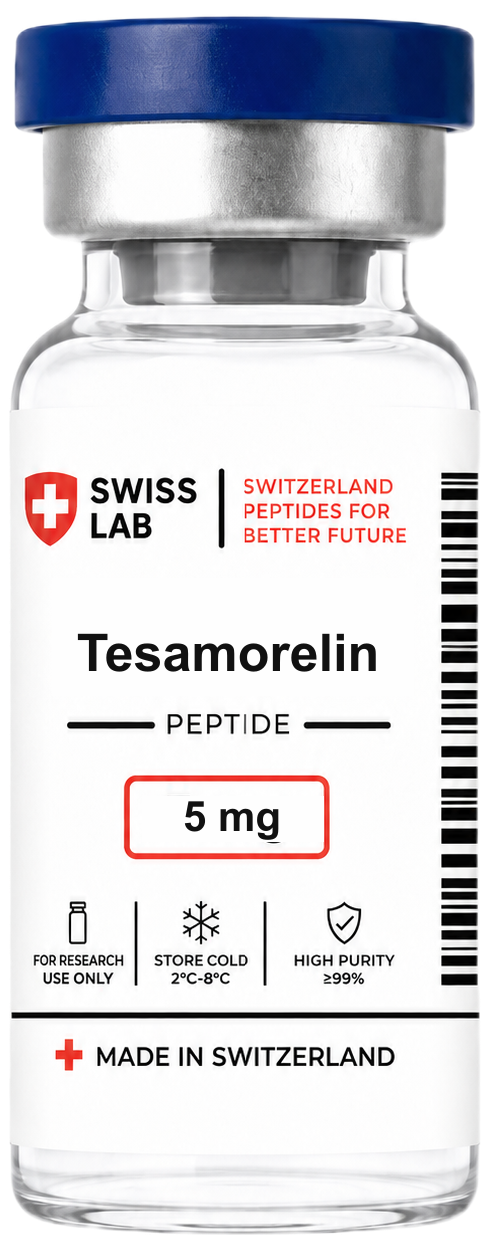
Tesamorelin sits on the other side of the line: a 44-residue peptide, and a growth-hormone-releasing-hormone analogue rather than growth hormone itself. It is a different molecule with a different target, and it is routinely confused with the subject of this page.
Frequently asked questions
- Is HGH a peptide?
- Not in any useful sense. Somatropin is a 191-residue protein of 22,124 g/mol; the peptides in this catalogue run from 9 residues and about 1,000 g/mol (oxytocin) to 44 residues and 5,135.9 g/mol (tesamorelin). The line between peptide and protein is conventional rather than exact, but 22 kDa is well on the far side of it, and the analytical consequences are real.
- What is the difference between 191aa and 192aa HGH?
- The 192-residue form is somatrem, the first recombinant growth hormone, which retained the N-terminal methionine that bacterial translation starts with. It is one residue and about 131 g/mol heavier than the 191-residue human sequence. Modern somatropin is the 191-residue form.
- Does a high HPLC purity figure mean the protein is correctly folded?
- No. Purity by HPLC is an area percentage of a chromatogram and folding does not appear in it. Nor does an intact mass: a correctly and an incorrectly paired disulfide bridge weigh the same. Aggregate content is a separate measurement, usually by size-exclusion chromatography.
- Is somatropin an authorised medicine?
- Yes, in the European Union and the United States, under many brand names. Research-grade material of the same sequence is a different regulatory object: it is not manufactured, released or labelled as that product, and it is supplied for laboratory research only.