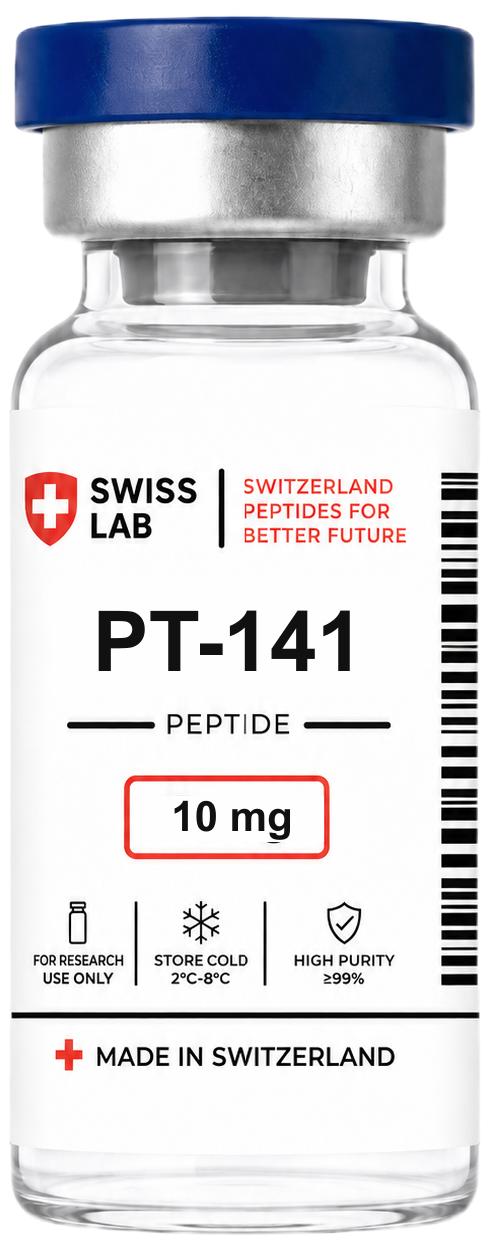
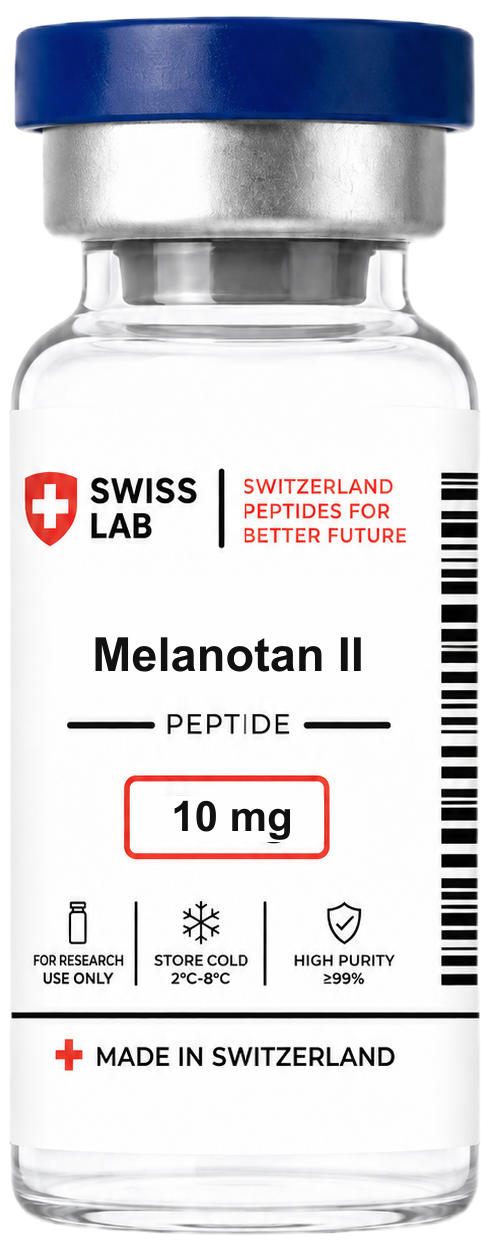
PT-141, known in the literature as bremelanotide, is a synthetic cyclic heptapeptide and a melanocortin receptor agonist. It is structurally close to Melanotan II — close enough that the two are routinely confused, and close enough that the difference between them is a single change at one end of the molecule.
It is also unusual among the compounds catalogued here: the molecule is an authorised medicinal product in the United States, under the name Vyleesi. That fact is the reason this overview exists in the form it does. Most research peptides invite the question "is this a medicine?" and the answer is a flat no. Here the honest answer is more precise, and the precision is the whole point.
- Synthetic cyclic heptapeptide; CAS 189691-06-3, C50H68N14O10, average molecular weight 1025.2 g/mol.
- A melanocortin receptor agonist, studied principally at the centrally expressed MC3R and MC4R subtypes.
- Structurally it is Melanotan II with a free C-terminal carboxylic acid in place of the amide — it is, in effect, the metabolite of that compound.
- The molecule is authorised as a medicine in the US under the name Vyleesi; research-grade material is a different regulatory object and is not that product.
- Supplied here as a lyophilised powder for in-vitro laboratory research only — not for human or veterinary use.
What the molecule is
Bremelanotide is a cyclic heptapeptide with the primary structure Ac-Nle-cyclo[Asp-His-D-Phe-Arg-Trp-Lys]-OH. The ring is closed by a lactam bridge between the aspartate and lysine side chains, which locks the peptide into a constrained conformation. That constraint is not decorative: linear melanocortin peptides are conformationally floppy and degrade quickly, and the cyclisation is what makes this family stable enough to study at all.
Its molecular formula is C50H68N14O10 and its average molecular weight is 1025.2 g/mol. The CAS registry number of the free base is 189691-06-3; the acetate salt, which is the form most commonly supplied, carries the separate number 1607799-13-2. A supplier quoting one of those two numbers is being specific; a supplier quoting neither is not describing a characterised compound.
How it differs from Melanotan II
Melanotan II is Ac-Nle-cyclo[Asp-His-D-Phe-Arg-Trp-Lys]-NH2. PT-141 is the same sequence, same ring, same stereochemistry — with -OH where Melanotan II has -NH2. One amide group at the C-terminus is the entire structural difference between the two molecules.
| Melanotan II | PT-141 (bremelanotide) | |
|---|---|---|
| C-terminus | Amide (-NH2) | Free carboxylic acid (-OH) |
| Molecular formula | C50H69N15O9 | C50H68N14O10 |
| Average molecular weight | 1024.2 g/mol | 1025.2 g/mol |
| CAS (free base) | 121062-08-6 | 189691-06-3 |
| Receptor profile studied | Non-selective across MC1R–MC5R | Studied mainly at MC3R / MC4R |
| Authorised as a medicine | No, in any jurisdiction | Yes — Vyleesi (US, 2019) |
That one-group difference has a history. PT-141 arose as a metabolite of Melanotan II: hydrolysis of the C-terminal amide converts one into the other. The programme that produced bremelanotide began from the observation that the metabolite had a receptor profile of its own worth pursuing separately.
The melanocortin receptor family
The melanocortin receptors — MC1R through MC5R — are class A (rhodopsin-like) G-protein-coupled receptors. They share an endogenous ligand family derived from proopiomelanocortin, and they are distributed very differently from one another: MC1R predominantly in pigment cells, MC2R in the adrenal cortex, MC3R and MC4R largely in the central nervous system, MC5R in exocrine tissue.
Where a melanocortin agonist acts therefore depends less on the compound than on which subtypes it engages and where those subtypes are expressed. Melanotan II engages the family broadly, including MC1R in the periphery. Bremelanotide has been studied principally as a centrally acting agonist at MC3R and MC4R, and it is that difference in emphasis — not a difference in chemical class — that separated the two development programmes.
The licensed medicine, and what it is not
In 2019 the US Food and Drug Administration approved bremelanotide, under the brand name Vyleesi, as a prescription medicine for a specific indication in a specific population. That approval is a matter of public record and there is no reason to be coy about it. It is also the single most misused fact about this compound.
An approval attaches to a product, not to a molecule in the abstract. Vyleesi is a finished pharmaceutical: manufactured under pharmaceutical quality systems, released against a registered specification, presented in a defined dosage form, accompanied by a label that a regulator reviewed, and dispensed on prescription. Research-grade bremelanotide is the same molecule and none of those other things. It is a laboratory reagent, and the approval says nothing whatsoever about it.
This is why no pharmacy dispenses research material and why it carries no pharmacy price: the two are different regulatory objects that happen to share a chemical structure. Anyone offering research-grade peptide on the strength of a medicine's approval is trading on a category error, and in most jurisdictions on an illegal one.
What the published record does not establish
The commercial material circulating under this name makes claims that go well beyond both the approved indication and the published literature. Several things are worth stating plainly:
- An approval in one jurisdiction, for one indication, in one defined population, does not generalise to other uses, other populations, or other jurisdictions. Bremelanotide holds no equivalent EU marketing authorisation.
- Nothing about the safety or quality profile of a licensed product transfers to material produced outside pharmaceutical quality systems. Impurity profile, sterility and content uniformity are properties of a manufacturing process, not of a molecular formula.
- The preclinical melanocortin literature is largely receptor pharmacology and animal-model work. It describes mechanisms; it does not license conclusions about outcomes in people.
- Regulators in several countries have issued warnings about unapproved melanocortin peptides sold direct to consumers, and those warnings apply to this compound family specifically.
Handling and verification
PT-141 is supplied as a lyophilised powder. Lyophilised peptide is markedly more stable than peptide in solution, which is why it is kept sealed, dry and cold until it is prepared for laboratory work, and why the date a vial was opened is worth recording.
For identity, three values should agree with an independent registry before anything else is considered: molecular formula C50H68N14O10, average molecular weight 1025.2 g/mol, CAS 189691-06-3. For purity, the relevant document is a certificate of analysis that reports HPLC purity with identity confirmed by mass spectrometry, dated, and carrying the same lot number as the vial in hand.
- A certificate that is not batch-specific documents nothing about the vial you received.
- A mass spectrum is what distinguishes bremelanotide from Melanotan II; the 1.0 g/mol difference is unambiguous by MS and invisible in a purity percentage.
- Purity and identity are separate claims. A material can be 99% pure and still be the wrong compound.
Frequently asked questions
- Is PT-141 the same thing as Melanotan II?
- No, though the two differ by a single group. PT-141 carries a free carboxylic acid at the C-terminus where Melanotan II carries an amide, which makes PT-141 in effect the metabolite of Melanotan II. They have different formulas, different CAS numbers, a 1.0 g/mol difference in mass, and different receptor emphases in the studied literature.
- Bremelanotide is an approved medicine — does that make this material a medicine?
- No. The approval attaches to Vyleesi, a finished pharmaceutical manufactured under pharmaceutical quality systems, released against a registered specification and dispensed on prescription. Research-grade bremelanotide is the same molecule and none of those other things. Same chemistry, different regulatory object; no pharmacy dispenses the research material and it has no pharmacy price.
- Can I check that what I received is bremelanotide and not Melanotan II?
- Yes, by mass spectrometry. The two compounds differ by 1.0 g/mol — bremelanotide is 1025.2 g/mol against Melanotan II's 1024.2 — which is trivially resolved by MS and completely invisible in an HPLC purity figure. That is why a certificate of analysis needs to report identity as well as purity, and why the lot number on it must match the vial.
- Why does the CAS number sometimes differ between suppliers?
- Because the free base and the acetate salt have separate registry numbers: 189691-06-3 for the free base, 1607799-13-2 for the acetate. Both are legitimate; they describe different forms of the same active moiety. A supplier quoting neither is the case worth worrying about.