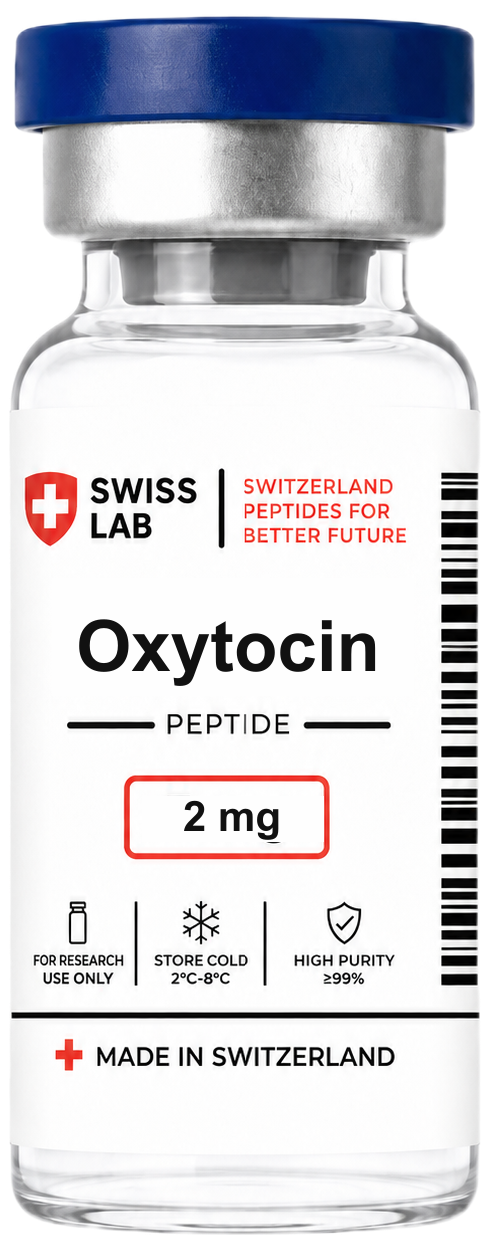
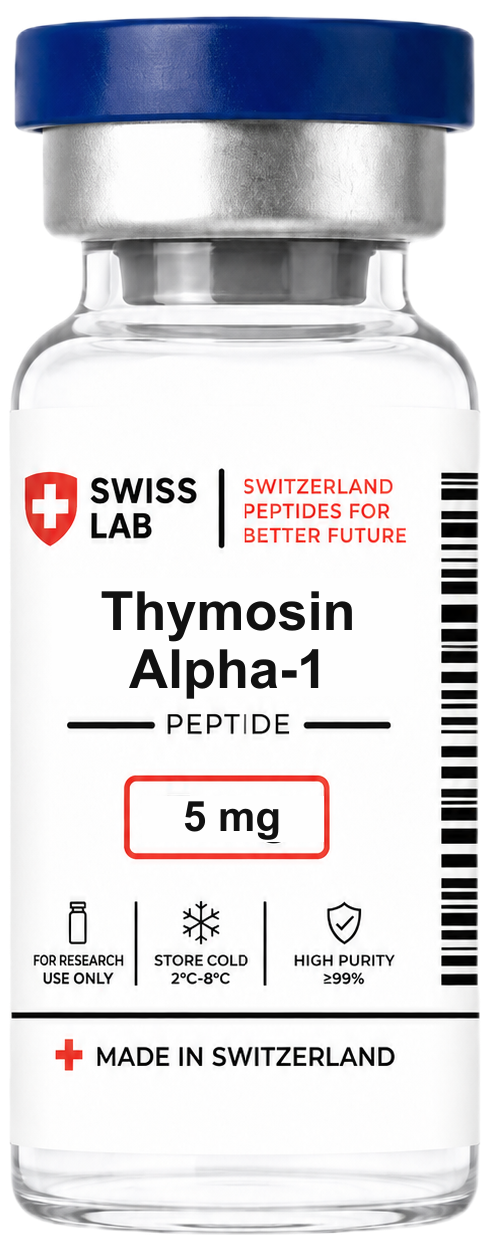
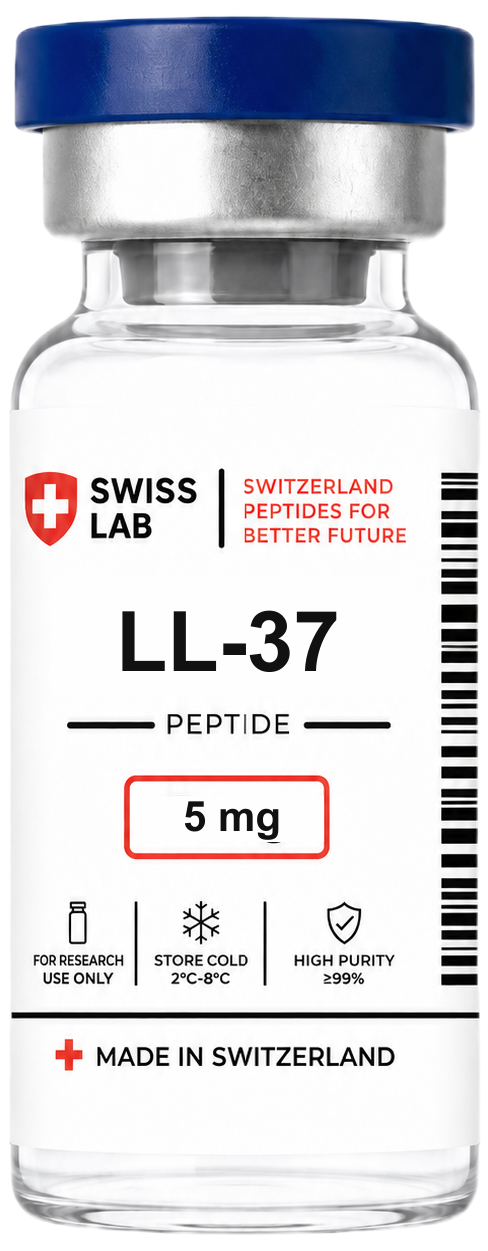
Read through any peptide catalogue and the word acetate turns up constantly — oxytocin acetate, LL-37 (human) acetate, and so on down the list. It is doing two entirely different jobs, and a reader who does not separate them will misread both the certificate of analysis and the mass printed on the vial.
In one sense it is a salt: acetate ions paired with the peptide's basic groups, left behind by the last purification step. In the other it is an acetyl group bonded to the peptide's N-terminus, which is part of the molecule and cannot be washed off. Thymosin alpha-1 is the compound where both senses meet in the same vial.
- An acetate counter-ion weighs 59.04 g/mol and is not part of the peptide's structure.
- An N-terminal acetyl group is covalent, adds about 42.04 g/mol, and is written as Ac- at the start of a sequence.
- Mass spectrometry reports the acetyl group and never sees the counter-ion, which dissociates before detection.
- HPLC purity is an area percentage of the chromatogram; it does not say how much of the powder's weight is peptide.
- The figure that answers that question is peptide content, and it is a separate determination.
Two different things, one word
A synthetic peptide is cleaved from its resin and purified by reversed-phase HPLC, normally in a mobile phase containing an acid. At that pH the basic side chains — lysine, arginine, histidine — and any free N-terminal amine are protonated, and every protonated site holds a counter-ion. Dry the collected fractions and those counter-ions stay behind in the powder. What comes out of the freeze-dryer is a peptide salt, and the anion is whichever acid was in the mobile phase.
An acetyl group is nothing of the kind. It is carbon, hydrogen and oxygen bonded to the N-terminal nitrogen in place of one hydrogen: a net addition of about 42.04 g/mol, written into the sequence itself. The sequence of thymosin alpha-1 begins Ac-Ser-Asp-Ala-Ala. That Ac- is the acetyl group, and a preparation without it is a different compound — 42 g/mol lighter, with a free amine where the acetyl should be.
Why mass spectrometry answers one question and not the other
Mass spectrometry is the standard identity check on a peptide certificate: it measures the mass of the ions the instrument makes from the sample. A covalent acetyl group travels with the peptide into the gas phase, so an acetylated peptide reads about 42 units heavier than the same sequence without it. For thymosin alpha-1 that is 3108.3 g/mol against roughly 3066 for the des-acetyl form — a gap any routine instrument resolves comfortably.